First Nations Advisory Group
Page last updated:23 September 2026
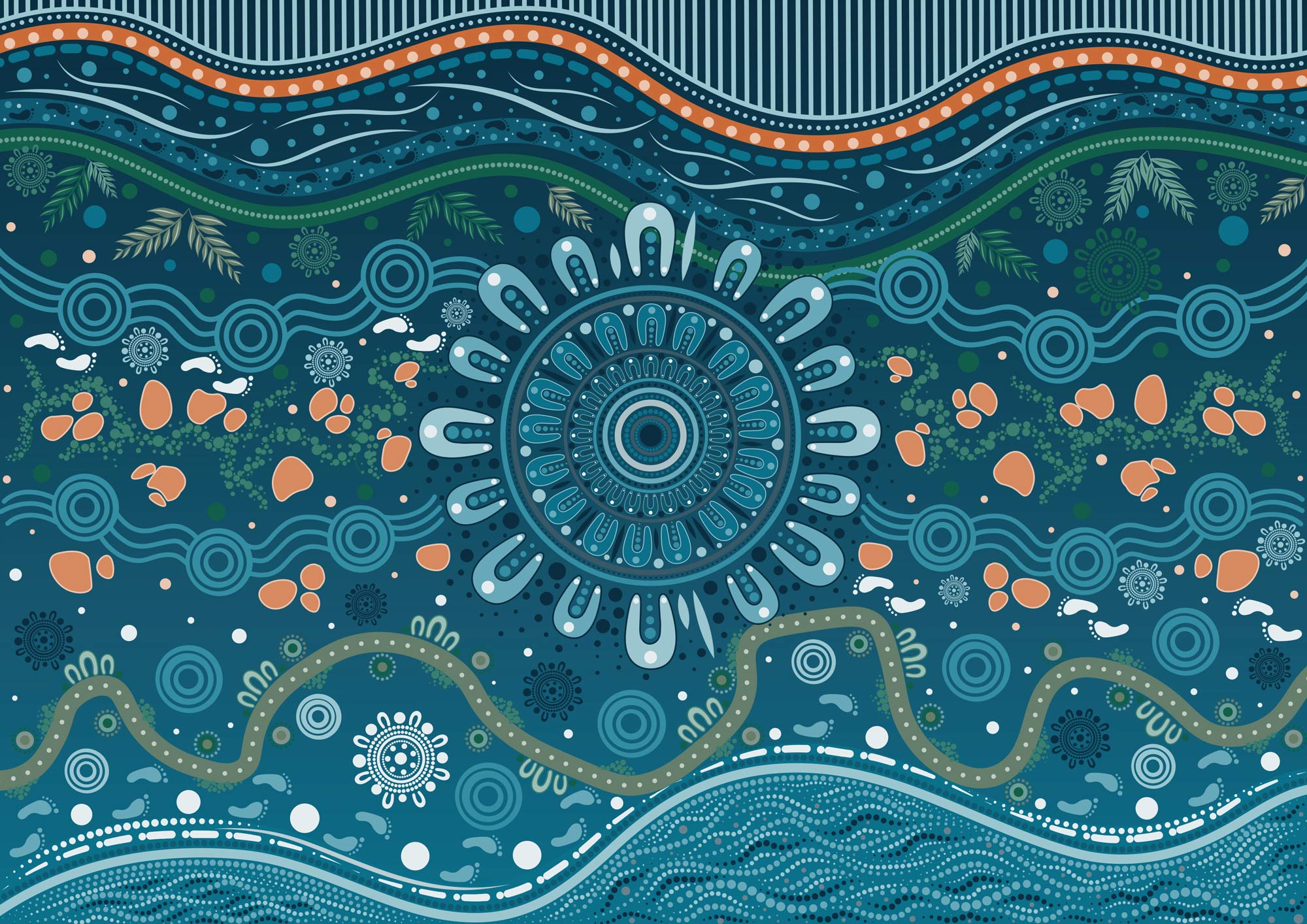
Geoscience Australia: A Journey of Connection Artwork by Lani Balzan
Geoscience Australia has established the First Nations Advisory Group to provide independent, culturally informed advice that strengthens the organisation's work and supports respectful, effective engagement and partnerships with Aboriginal and Torres Strait Islander peoples, communities and organisations.
The Advisory Group brings together First Nations leaders and experts who provide strategic insights and guidance on matters relevant to Geoscience Australia's functions and priorities. Their knowledge and experience will help ensure that the organisation’s geoscience and geospatial programs and activities are informed by cultural knowledge, community priorities and principles of partnership and mutual respect.
The Group will play an important role in supporting Geoscience Australia's commitment to working collaboratively with Aboriginal and Torres Strait Islander peoples and recognising their enduring connection to Country.
The establishment of the Advisory Group supports the vision and objectives of Shaping Our Future: Geoscience Australia Strategy 2026-2036, reinforcing the organisation's commitment to embedding First Nations perspectives in its work and delivering outcomes that create value for all Australians.
The first meeting of the Advisory Group is scheduled for September 2026.
Why the Advisory Group matters
Aboriginal and Torres Strait Islander peoples have cared for Country for tens of thousands of years and hold deep cultural knowledge, perspectives and expertise that are highly relevant to Geoscience Australia's work across Australia's land, waters and resources.
The First Nations Advisory Group provides a dedicated mechanism for Geoscience Australia to listen to, learn and work in partnerships with Aboriginal and Torres Strait Islander peoples in a meaningful and culturally respectful way. The Group will help ensure that First Nations perspectives inform the organisation's strategic priorities, programs and activities.
The Advisory Group will also help strengthen relationships with Aboriginal and Torres Strait Islander peoples and communities and enhance how Geoscience Australia engages, communicates and shares information across its areas of work, including Resourcing Australia's Prosperity.
Advice from the Group will help inform approaches to partnership, engagement and communication, while supporting greater accessibility, discoverability and usability of Geoscience Australia's geoscience and geospatial information. This will contribute to informed decision-making and support the sustainable and responsible management of Country for the benefit of current and future generations.
Inaugural membership
The Advisory Group’s inaugural membership brings together First Nations leaders with expertise across science, governance, policy, business, cartography, community leadership and STEM engagement.
Appointed Members
Mitchell Baum is a Larrakia man and researcher in physical geography at the University of Melbourne.
His work focuses on environmental change, cultural landscapes and the relationship between Indigenous knowledge systems and environmental science. Mitchell’s research contributes to the ARC Centre of Excellence for Indigenous Environmental Histories and Futures, which brings together Indigenous knowledge and environmental history to deepen understanding of how people and landscapes shape one another over time.
Mitchell also brings experience from advisory and governance settings. He has contributed to the Larrakia Advisory Group for the Darwin Harbour Waterways Catchment Project, where he has provided environmental and physical geography expertise as a Larrakia man. He is also a member of the Academic Advisory Group for the Point Nepean Research and Education Field Station and has served on the Teaching and Learning Committee for the University of Melbourne’s School of Geography, Earth and Atmospheric Sciences.
Dennis Ah-Kee is a Wanjuru Elder from Queensland with extensive experience in environmental governance and Indigenous policy.
He currently serves as the Indigenous representative on the Scientific Advisory Committee of the Wet Tropics Management Authority and is also a member of the Reef Advisory Committee. Earlier in his career, Dennis contributed to national policy discussions through his work with the National Aboriginal Conference, including involvement in the development of the Draft National Land Rights Proposal.
Dennis brings a strong understanding of the intersection between Indigenous governance, environmental management and policy development. His experience is particularly relevant to Geoscience Australia’s work where geoscience information, environmental stewardship and community engagement overlap.
Professor Deen Sanders is a proud Worimi man and a nationally recognised Indigenous leader in governance, ethics, systems change and strategic leadership.
He currently chairs the Commonwealth Government’s National Indigenous Tourism Advisory Group and has held significant leadership roles in national and international forums, including as Chair of the World Economic Forum’s Values and Systems Change Leadership Group and Co-Chair of the World Economic Forum’s Global Future Council on Natural Capital. He also serves on boards including the Indigenous Knowledge Systems Collective and the Centre for Policy Development.
Professor Sanders’ experience spans government, policy, systems reform and values-based leadership. He brings a strong understanding of governance, long-term strategic change and the importance of culturally informed decision-making in institutions.
Michael O’Keeffe is a geospatial specialist and proud Quandamooka man with extensive experience in geospatial analysis, remote sensing and environmental modelling.
He has led and contributed to the development of geospatial products used to support environmental and water resource assessments, including the National Agricultural Monitoring System used in drought declarations. His work has included geospatial and statistical analysis for water assessments and the development of remote sensing products using Landsat and LiDAR data. He is also a member of the Future Drought Fund’s First Nations Advisory Group.
Michael brings deep practical knowledge of geospatial tools, Earth observation and how geoscience data can be applied to real-world decisions about land, water and environmental change.
Craig Molyneux is a Gunditjmara man and highly experienced cartographer with nearly four decades of experience in the spatial and mapping industries.
He currently on the Board of the Gunditj Mirring Traditional Owners Aboriginal Corporation and serves on the Board of the International Map Industry Association (Asia Pacific). Craig holds a Master of Science in cartography from RMIT University and has worked extensively in map design, geospatial information systems and digital mapping technologies.
Craig brings specialist expertise in mapping, cartography and spatial information, as well as strong governance experience through his work with Traditional Owner organisations.
Through the First Nations Advisory Group, Craig contributes insight into how mapping and spatial data can support land management, stewardship, communication and informed decision-making.
Sharon Cavanagh-Luskin is a proud Kuuku Ya’u, Irukandji and Wonnarua woman and First Nations science advocate, STEM leader and science communicator with experience spanning science engagement, leadership and community outreach.
She has played a leading role in delivering international science festivals and currently serves as Deputy Chair of the Queensland Child Death Review Board. Her work reflects a strong commitment to increasing representation of First Nations peoples in science and technology and creating pathways for young people into STEM.
Sharon brings an important perspective on science communication, community engagement and how technical or specialist knowledge can be made more accessible and meaningful to broader audiences.
Amy Rust is a senior policy and governance specialist with extensive experience across Aboriginal-led organisations, ministerial advisory work and public policy.
Her experience includes executive leadership roles within the First Peoples’ Assembly of Victoria, including as Acting CEO, and service as Chief of Staff and Principal Adviser to Ministers across federal, state and territory governments. She currently serves on the board of the National Homeless Collective.
Amy brings deep expertise in governance, public policy, institutional reform and engagement with Aboriginal-led organisations. She understands how large institutions work, how policy is shaped, and how governance and community engagement need to align to support better outcomes.
Kado Muir is a cultural leader and senior knowledge holder from the Ngalia dialect family of the Mantjiltjara language group, with traditional territorial ties in the Western Deserts of Western Australia.
Kado is Chair of the National Native Title Council, Co-founder of the First Nations Heritage Protection Alliance, and a Co-founder member of the First Nations Clean Energy Network.
Kado brings deep traditional knowledge, native title expertise and cultural heritage governance experience, along with a strong understanding of how Traditional Owner rights, land management and cultural protection intersect with geoscience and resource-related activities. His leadership on native title, heritage protection and the transition to clean energy will help Geoscience Australia think carefully about self-determination, Country-based knowledge and the practical implications of its work for Traditional Owners and communities.
Further information
For further information regarding the First Nations Advisory Group, please contact the First Nations Engagement and Partnerships Directorate via email at FirstNationsAdvisoryCoordinator@ga.gov.au