News
Ancient fossil from Antarctica brings deep time science to the National Museum of Australia
Published:2 July 2026
From 1 July 2026, visitors to the National Museum of Australia's (NMA) new Antarctica exhibition will come face to face with a piece of Antarctic history, a fossilised skull of Australodelphis mirus, an extinct dolphin.
The specimen, on loan from the Palaeontology Collection of Geoscience Australia’s National Mineral and Fossil Collection, is one of the first known Antarctic vertebrate fossils from the past 30 million years.
Living at a time when Earth’s climate was warmer than it is now, Australodelphis mirus provides researchers with valuable insight into how climate influences evolution due to factors such as food availability and offers scientists a rare window into how the Antarctic environment responds to a warming climate.
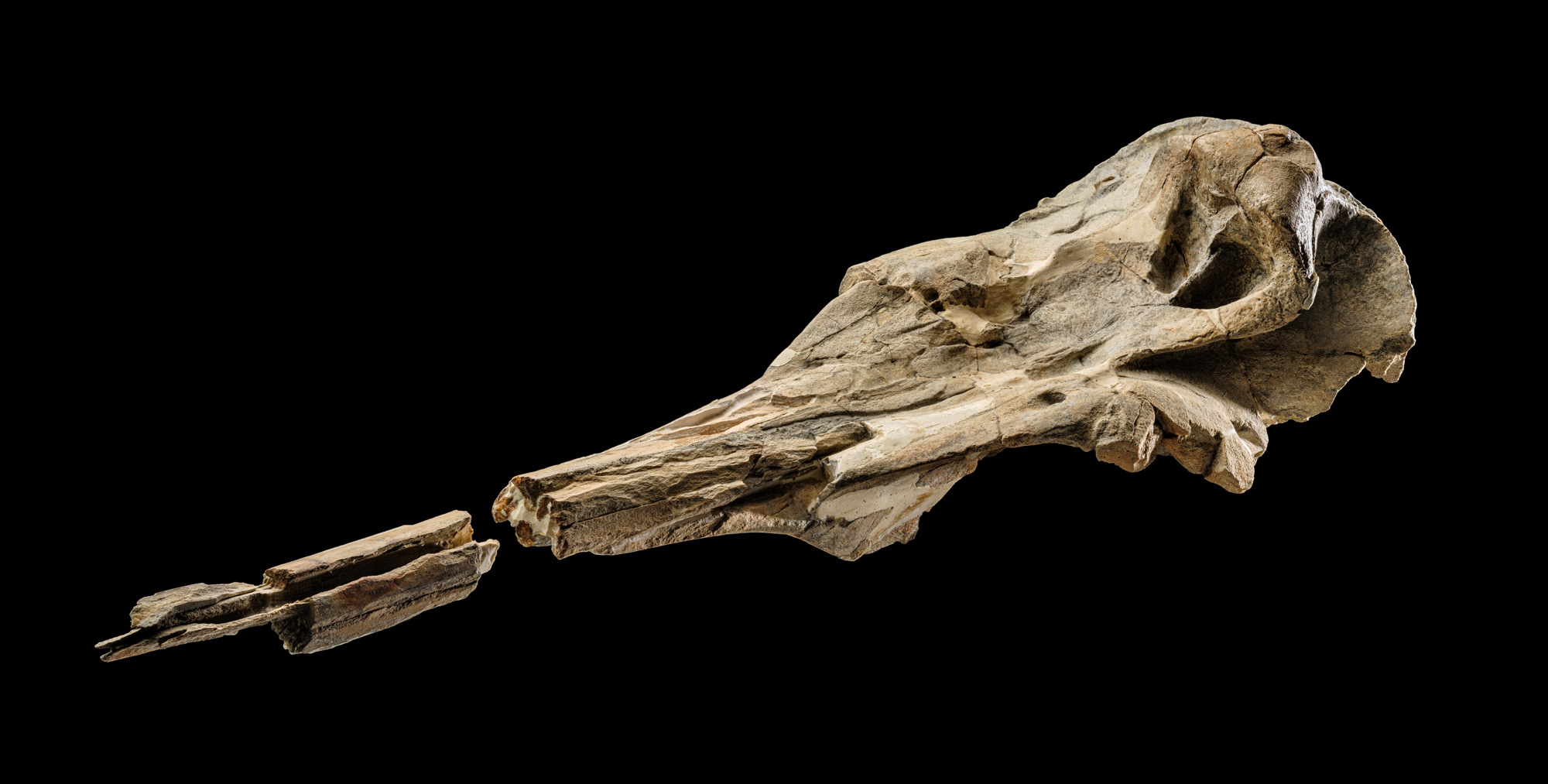
A Cetacean (dolphin) skull fossil in three pieces © National Museum of Australia
Geoscience Australia provides trusted information and insights about the land, marine and coastal geography of Australia and external territories, including the Australian Antarctic Territory. We advance Australia’s national interests in Antarctica by leading world-class science and supporting environmental stewardship.
Dr Steph McLennan, Director of Antarctic Geoscience at Geoscience Australia, contributed a feature article to NMA’s The Museum magazine which explores some of this science in further detail. Explaining how, through Earth science, geologists can trace the deep geological relationship between Australia and Antarctica, continents that drifted apart more than 130 million years ago but still share a common ancestry stretching back over 2.5 billion years.
‘Geologists piece together continents now separated by oceans by combining comparisons of rock samples, field observations and geophysical imaging,’ Dr McLennan said.
‘By matching rock types, their ages, and fossils, we can fingerprint the timing of major geological events across vast distances and deep time.’
Dr McLennan's article describes how geologists use tools like zircon geochronology and geothermal heat measurements, taken from rocks as close to home as the Nullarbor Plain, to help understand conditions far beneath the Antarctic ice sheet today. That research feeds directly into ice sheet models used to predict future sea-level rise.
But while progress has been made in understanding Antarctica’s history, we are only at the tip of the iceberg.
‘Antarctica's geology is still very much a work in progress,’ Dr McLennan said.
‘It's not a frozen outlier - it's a vital part of the Earth's and Australia's story. Deciphering it helps us understand not just where we've come from, but where we may be headed.’
The exhibition is a welcome opportunity to recognise the contribution of people like Dr McLennan, and the broader teams across Geoscience Australia whose work supports the Australian Antarctic Program through knowledge generation, capability building and international collaboration.
Through first-hand stories of early explorers through to recent expeditioners, Antarctica traces more than 100 years of Australians in Antarctica. The exhibition opens 1 July 2026.
Visit the exhibition
The National Museum of Australia
1 July to 11 October
9am to 5pm
Free – bookings essential
Antarctica | National Museum of Australia
Learn more about our work in Antarctica
Antarctica | Geoscience Australia