News
New facilities strengthen Australia’s critical minerals capability
Published:13 May 2026
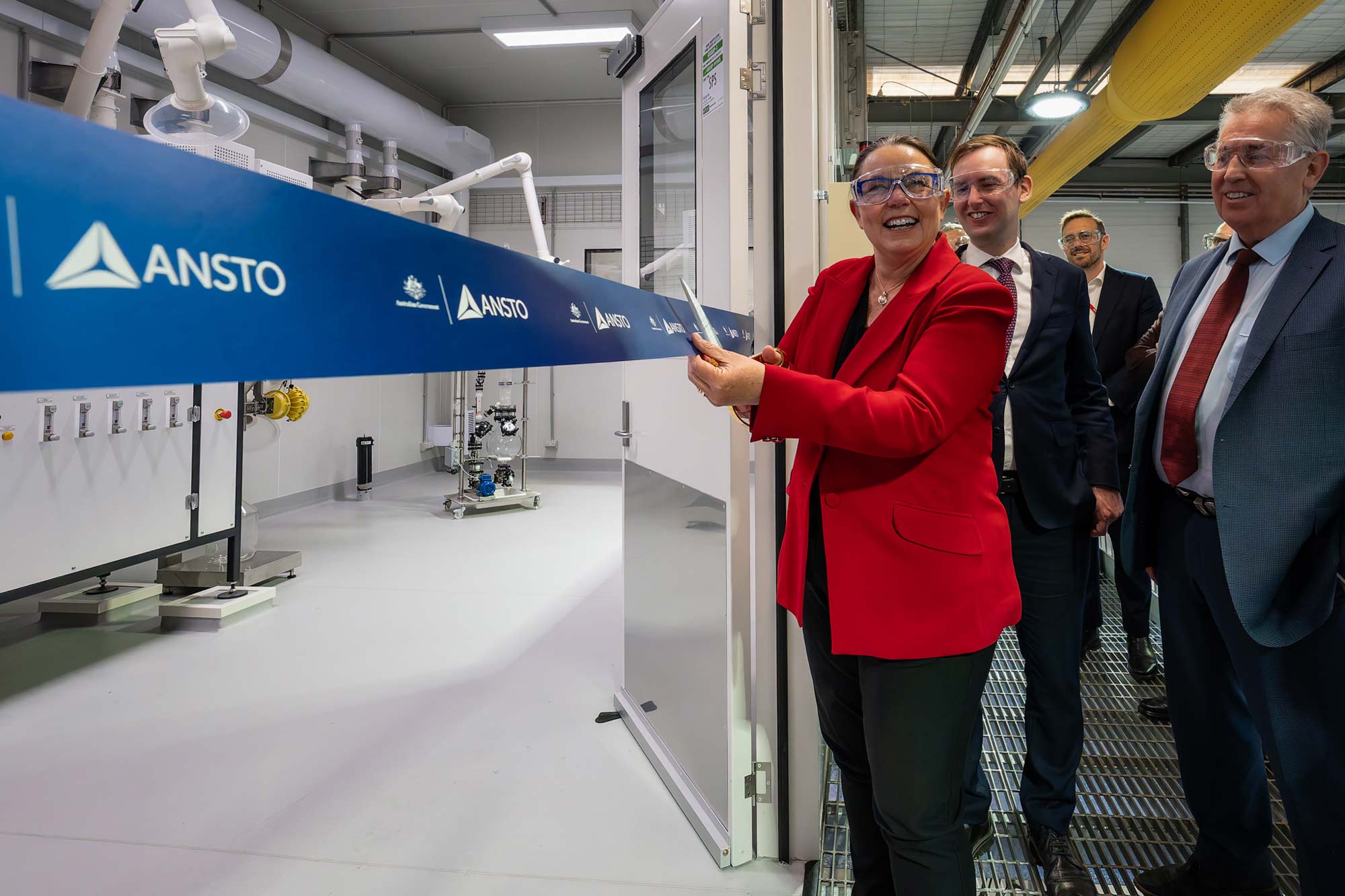
Minister for Resources and Northern Australia the Hon Madeleine King MP officially opens new critical minerals facilities at ANSTO’s Lucas Heights campus.
Australia’s critical minerals capability has been strengthened with the opening of two new Australian Nuclear Science and Technology Organisation (ANSTO) facilities at Lucas Heights campus in Sydney.
The facilities – Australia’s first purpose-built clay-hosted rare earth pilot processing plant and a high temperature chlorination facility – were officially opened by the Hon Madeleine King MP, Minister for Resources and Minister for Northern Australia.
The new facilities have been developed with support from the Australian Critical Minerals Research and Development (R&D) Hub to support industry to test and validate critical mineral processing pathways, helping to reduce project risk, time and cost in feasibility studies.
The clay-hosted rare earth pilot processing plant is designed to process material from clay-hosted deposits, which can be rich in heavy rare earth elements used in renewable energy technologies.
The high temperature chlorination facility will help industry assess whether projects can produce high-purity quartz, a crucial input for semiconductors, renewables, medical and defence equipment.
The facilities support the Australian Government’s Future Made in Australia agenda by helping build capability for more processing and value-adding onshore.
Minister King said shared-user facilities were important to diversifying global supply chains for critical minerals and rare earths that are crucial for national and economic security for Australia and its trading partners.
‘Developing facilities to support Australia’s processing capability will help strengthen our domestic critical minerals industry and create jobs, and is key to reducing reliance on overseas supply chains,’ Minister King said.
Geoscience Australia’s contribution through the Hub is focused on trusted national-scale data, mineral potential assessments and integrated geoscience insights that help government and industry understand Australia’s critical minerals opportunities.
This includes both Hub projects associated with the new ANSTO facilities, including the High Purity Silica / High Purity Quartz project and the Accelerating the Development of Australia’s Rare Earth Resources project.
Geoscience Australia Chief Executive Officer Ms Melissa Harris said the facilities demonstrated the value of collaboration across government, science and industry.
‘Geoscience Australia is proud to be part of the Australian Critical Minerals R&D Hub, alongside ANSTO and CSIRO. These new facilities show what is possible when Australia’s national science agencies work together to address practical challenges for industry,’ Ms Harris said.
‘Rare earth elements provide vital inputs to the modern economy and are included in Australia's Critical Minerals Strategic Reserve.
‘Geoscience Australia’s mineral prospectivity maps for clay-hosted rare earths and heavy mineral sands with rare earth potential, will support exploration for these minerals by industry and the development of more resilient supply chains.’
‘By combining our applied national geoscience with ANSTO and CSIRO’s technical expertise, facilities and know-how, we are helping to address technical challenges and deliver practical solutions aligned with the Australian Government’s Critical Minerals Strategy.’
The facilities are part of the expansion of ANSTO’s critical minerals capabilities, supported by the Australian Critical Minerals R&D Hub.
Learn more about Geoscience Australia’s work on critical minerals.