What are critical minerals?
Page last updated:19 October 2026
Critical minerals are minerals or elements essential to modern technologies, economies or national security, and that have supply chains at risk of disruption.
Australia lists 31 commodities as critical minerals along with 5 commodities regarded as strategic materials. These have been selected by assessing Australia’s geological endowment and potential with global technology needs. Assessments of mineral criticality reflect market and political conditions at a particular point in time and are subject to change. Australia’s 31 critical minerals and 5 strategic materials are shown in the figure below.
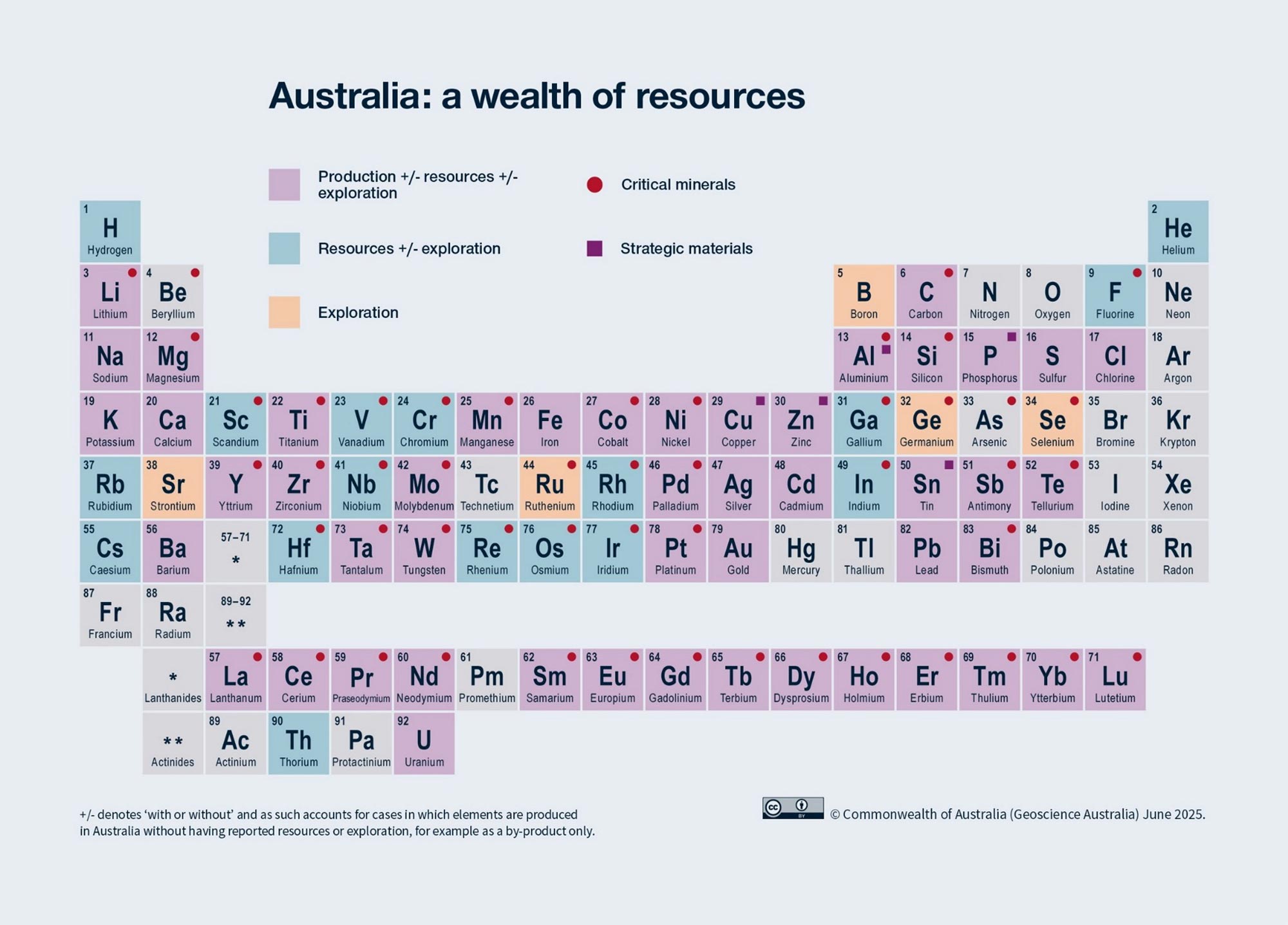
Figure 1. Periodic table of the elements showing commodities that are being produced, have reported Mineral Resources or are being explored for in Australia.
Critical minerals are used to manufacture advanced technologies including mobile phones, computers, fibre-optic cables, semi-conductors, banknotes, defence, aerospace and medical applications. Many critical minerals are used in low-emission technologies such as electric vehicles, wind turbines, solar panels, and rechargeable batteries, while some are also crucial for common products such as stainless steel and electronics.
Critical mineral supply chains are at risk when mineral production or processing is dominated by individual countries or companies that could limit availability. Other risks include market immaturity, political decisions, social unrest, natural disasters, mine accidents, geological scarcity, pandemics, and war.
Critical minerals, their uses and properties
Critical minerals are the hidden powerhouses driving our modern world. From the lithium in your smartphone and electric vehicle, to the rare earth elements inside wind turbines and advanced medical tech. These essential materials make today's lifestyle possible. As the world rapidly shifts toward clean energy and smarter technology, these finite resources have become more valuable, and harder to secure than ever before.
Click through each of the critical minerals to find out more information about the properties, usages, geological occurrence and extraction techniques .
High-purity alumina (HPA) is a refined form of aluminium oxide (Al2O3). It is a high-purity, white crystalline powder form, characterised by its purity levels (i.e. 99.99% Al2O3).
Properties
HPA has superior chemical stability, a high melting point, high hardness, good thermal conductivity and high electrical insulation. It also has remarkable scratch resistance.
Usages
HPA is used in the automotive and aerospace sector and is an important component of lithium-ion batteries and high-performance electronics and optics. Its properties make it a key component in sapphire glass (or synthetic sapphire) which is used in demanding optical and technology applications such as lasers.
Occurrence
The crustal abundance of aluminium is 8.2%. It is the most abundant metal and third most abundant element in the crust. HPA is not naturally occurring. It is manufactured and refined from aluminium oxide. HPA is predominately refined from aluminium oxide extracted from kaolin clays and refined aluminium known as feedstock.
Geological occurrence
Most of the aluminium-rich mineral resources that can be used as feedstock for HPA occur in sedimentary geological environments.
Extraction
HPA production takes an aluminium-rich starting material, such as kaolin, and uses a series of chemical purification steps to remove almost all other elements, producing aluminium oxide that can be more than 99.99% pure.
Antimony (Sb) is an unusual element because it has characteristics of metals and non-metals. It is generally described as a metalloid or semi-metal.
Properties
Antimony is a silvery, hard and brittle semi-metal. Its chemical properties allow it to form a range of useful compounds and alloys, supporting applications including flame retardants, batteries and semiconductor technologies.
Usages
Antimony is primarily used in flame-retardant materials and metal alloys, including lead used in batteries and ammunition. It is also used in products such as glass, ceramics and rubber and is a component of micro-capacitors.
Occurrence
Antimony is most commonly found in the sulphide mineral stibnite (Sb₂S₃). Significant antimony deposits can occur in sedimentary rock sequences associated with major faults and fracture systems. Antimony is relatively rare in the Earth's crust, with an estimated crustal abundance of 0.2–0.5 parts per million (ppm).
Geological occurrence
Antimony mineralisation is commonly associated with sedimentary rocks and fault and fracture systems, with stibnite being the principal ore mineral. Mineralisation occurs in a range of geological settings, including those associated with volcanic and hydrothermal activity, mountain-building processes, and sedimentary basins.
Extraction
Antimony is typically extracted from the mineral stibnite. It can also be recovered as a co-product alongside gold where the two occur together. After the ore is mined and concentrated, it is commonly treated at high temperatures to recover the antimony, which is then refined to remove impurities and produce the required product.
Arsenic (As) has characteristics between those typically associated with metals and non-metals and is classified as a semi-metal or metalloid. Arsenic occurs in three main forms, known as allotropes: grey, black and yellow. Grey is the most common, and is a tin-white colour, which oxidises dark grey to black. Allotropes are different structural forms of the same element, which can have different physical properties.
Properties
Arsenic is a brittle, silver-grey metalloid. It occurs in several forms and has properties that make it useful in specialised applications, including semiconductor technologies. Arsenic and many of its compounds are also toxic.
Usages
Arsenic is used in semiconductor technologies, including gallium arsenide, as well as in specialised glass and metallurgical applications. Arsenic is primarily used in alloys of lead for lead car batteries and ammunition. Arsenic compounds have also been used in products such as wood preservatives
Occurrence
Arsenic rarely occurs naturally in its elemental form. It is commonly found in minerals associated with copper, iron and lead ores, with arsenopyrite (FeAsS) being the most abundant arsenic-bearing ore mineral. Arsenic is relatively uncommon in the Earth's crust, with an estimated crustal abundance of about 1.8 ppm.
Geological Occurrence
Arsenic occurs in a range of geological environments and can become concentrated through magmatic and hydrothermal processes. It is commonly associated with mineral deposits containing gold, copper, tin and tungsten.
Extraction
Arsenic is generally recovered as a by-product of processing other metals, particularly copper, gold and lead. It can be collected from dust produced during smelting and can also be obtained by heating arsenopyrite.
Beryllium (Be) is a lightweight, silvery-white metal valued for its combination of low density, high stiffness and ability to withstand high temperatures.
Properties
Beryllium is a lightweight, silvery-white metal with a high melting point (1,287°C) and useful thermal and electrical properties. Its combination of low density and high stiffness makes it valuable for specialised applications where low weight and dimensional stability are important.
Usages
Beryllium is used in aerospace, electronics, medical equipment and other specialised applications. It is also alloyed with copper and nickel to make components including springs, electrical contacts and non-sparking tools.
Occurrence
Beryllium does not occur naturally as a free metal and is found in a range of minerals. The principal commercial sources are beryl and bertrandite. It has a crustal abundance of 2 ppm in igneous rocks.
Geological Occurrence
Many beryllium deposits are hosted in pegmatites, which are very coarse-grained igneous rocks. Beryllium mineralisation can also occur in metamorphic rocks such as skarn and schist, and in some altered volcanic rocks.
Extraction
Beryllium is extracted from ores containing minerals such as bertrandite and beryl. The ore is processed to separate the beryllium and produce beryllium hydroxide, an intermediate product that can then be converted into beryllium metal, beryllium oxide or beryllium alloys.
Bismuth (Bi) is a metallic element with a silver-white appearance and an iridescent tarnish. It is regarded as relatively non-toxic compared with many other heavy metals, which has allowed it to substitute for lead in some applications.
Properties
Bismuth is a metallic trace element. Its alloys with metals such as tin and cadmium can have low melting points. It is considered relatively non-toxic and diamagnetic.
Uses
Bismuth is used in solders, alloys, metallurgical additives and medicines, and is used as a replacement for lead in products such as ceramic glazes, fishing sinkers and free-machining brasses. It is also used as an additive to enhance metallurgical quality in foundry applications and as a triggering mechanism in fire sprinklers.
Occurrence
Bismuth can occur naturally as native metal, but more commonly occurs in sulphide or oxide minerals. It can also be incorporated into common sulphide minerals including sphalerite, galena and chalcopyrite. Its estimated abundance in the upper continental crust is approximately 0.23 ppm.
Geological Occurrence
Bismuth is associated with sulphide-bearing mineral occurrences and can occur with minerals containing lead, zinc and copper. Bismuth can also have relatively elevated concentrations in granitic rocks and sulphide-bearing mineral occurrences.
Extraction
Bismuth is produced mainly as a by-product of lead ore processing, rather than being mined principally.
Chromium (Cr) is a metal valued particularly for its ability to improve the corrosion resistance, oxidation resistance, hardness, wear resistance and high-temperature strength of other metals.
Properties
Chromium's important metallurgical properties include its ability to increase hardenability, wear resistance and strength at elevated temperatures, while providing corrosion and oxidation resistance.
Uses
Chromium is an essential ingredient in stainless steel and superalloys. Chromium compounds are also used to produce chromium chemicals, while chromium metal has specialised applications.
Occurrence
Chromium makes up about 0.01% of the Earth’s crust and is more concentrated in certain iron- and magnesium-rich rocks, where it commonly occurs in the mineral chromite.
Geological Occurrence
Chromite deposits are associated particularly with ultramafic rocks, where chromium can occur as massive or disseminated mineralisation
Extraction
Chromium is recovered from chromite, sometimes as a co-product with platinum-group metals. Chromite can be processed and refined into ferrochromium or chromium oxide. Ferrochromium is predominantly used in stainless-steel production and can also be further processed to make high-purity chromium metal.
Cobalt (Co) is a silvery-grey metal valued for properties including magnetism, high-temperature performance, and hardness and wear resistance when alloyed with other metals.
Properties
Cobalt is ferromagnetic, has a high melting point, and can increase hardness and wear resistance when alloyed with other metals. It also produces an intense blue colour when combined with silica.
Uses
Cobalt is used principally in rechargeable battery electrodes and superalloys for gas-turbine engines. Other applications include magnets, catalysts, hard metal and diamond tools, corrosion- and wear-resistant alloys, pigments and high-speed steels.
Occurrence
Cobalt is a naturally occurring but relatively uncommon metal in the Earth’s crust. It has an average crustal abundance of about 25 ppm. Major cobalt-bearing minerals include cobaltite and cobaltian pyrite.
Geological Occurrence
Major geological settings include magmatic nickel-copper-cobalt-PGE sulphide deposits, sediment-hosted copper-cobalt sulphide and oxide deposits, and nickel-cobalt laterite deposits. Cobalt resources also occur in iron-manganese nodules and crusts on the seafloor.
Extraction
Cobalt is frequently recovered alongside other commodities. Cobalt is a co-product of copper processing and a by-product of nickel, platinum-group-element and zinc operations.
Fluorine (F) is the element, but fluorspar (fluorite, CaF2) is the principal commercially mined mineral source of fluorine. Fluorite is the only fluorine mineral mined on a large scale.
Properties
Fluorine is pale-yellow, highly reactive, and is a toxic gas under standard conditions. Fluorine's commercial importance is largely realised through fluorine compounds rather than elemental fluorine. Fluorite, is calcium fluoride and provides an important industrial source of fluorine.
Uses
Fluorine compounds are used in lithium-ion batteries, semiconductor manufacturing, electrical insulation and solar technologies. They are also important in the manufacturing of fluoropolymers such as Teflon, uranium processing, steel and aluminium production, cement manufacturing, and specialised applications such as rocket propellants.
Occurrence
Fluorine is relatively common in the Earth’s crust, making up about 0.06%. It does not usually occur on its own. Instead, it is found in minerals such as fluorite, apatite and some micas.
Geological Occurrence
Most deposits mined for fluorine are hydrothermal, meaning the minerals precipitated from hot, mineral-rich fluids. Fluorine also becomes concentrated in evolved igneous rocks and associated hydrothermal deposits, while relatively high concentrations can occur in sedimentary phosphorites.
Extraction
Fluorine is principally obtained by mining and processing fluorspar. Fluorspar provides the fluorine used to manufacture hydrogen fluoride or hydrofluoric acid, which is subsequently used as feedstock for numerous fluorine-containing chemicals. Fluorine can also be recovered as fluorosilicic acid, a by-product of some phosphoric-acid production.
Gallium (Ga) is a soft, silvery metal notable for its very low melting point of about 30°C and its importance in advanced semiconductor technologies.
Properties
Gallium is a soft, silvery metal with a melting point of approximately 29.8°C, meaning it can melt around human body temperature. It also has a very high boiling point (2,204°C). Its technological importance comes particularly from compounds such as gallium arsenide (GaAs) and gallium nitride (GaN), which have valuable semiconductor properties.
Uses
Gallium is used principally in semiconductor and optoelectronic technologies. Gallium arsenide and gallium nitride are used in integrated circuits, LEDs, laser diodes, photodetectors, power and radio-frequency electronics and solar cells. These technologies support applications including telecommunications, aerospace, defence, high-performance computing and consumer electronics.
Occurrence
Gallium is a relatively uncommon metal in the Earth’s crust, with an average abundance of roughly 0.002%. Gallium generally occurs in small concentrations dispersed through other minerals rather than forming major gallium ore minerals. It can substitute for chemically similar elements such as aluminium and zinc. For example, it occurs in aluminium-bearing minerals that form bauxite deposits, and in sphalerite, a zinc sulphide mineral.
Mineralisation setting
Gallium is associated principally with bauxite deposits and certain zinc deposits. Gallium-bearing sphalerite occurs in sediment-hosted, Mississippi Valley-type and volcanogenic massive sulphide deposits.
Extraction
Gallium is predominantly recovered as a by-product of processing bauxite ore for aluminium. Smaller quantities can also be recovered as a by-product of processing zinc ores.
Germanium (Ge) is a hard, brittle, greyish-white metalloid with semiconductor properties, meaning its electrical behaviour lies between that of a conductor and an insulator.
Properties
Germanium has a metallic lustre but is brittle like glass. Its semiconductor properties and optical characteristics make it particularly useful in electronic, fibre-optic and infrared technologies.
Uses
Germanium is used in fibre-optic telecommunications, infrared optics and night-vision equipment, semiconductors, solar cells and catalysts used in plastics production.
Occurrence
Germanium is a rare element in the Earth’s crust, with an average abundance of about 1.5 ppm. Germanium generally occurs in small concentrations within other minerals rather than as discrete germanium minerals. It commonly occurs as a trace component in sphalerite, a zinc sulphide mineral, and can also be concentrated in some coals. Discrete germanium sulphide minerals are comparatively rare.
Geological occurrence
Germanium is enriched in several geological environments, particularly sulphide ore deposits, sediment-hosted deposits, iron oxide deposits, pegmatites, greisens, skarns and some coal deposits.
Extraction
Germanium is mainly recovered as a by-product of zinc processing and can also be recovered from coal ash. Germanium-bearing residues are leached and concentrated, then further purified into compounds such as germanium tetrachloride, which can subsequently be converted into germanium dioxide or metal depending on the end use.
Graphite is a naturally occurring crystalline form of carbon. It is generally grey to black, opaque and relatively soft, with a metallic-earthy lustre.
Properties
Graphite has an unusual combination of high electrical and thermal conductivity, high thermal resistance, chemical inertness and lubricity. It is flexible but not elastic.
Uses
Graphite is used as an anode material in lithium-ion and other batteries. It is also used in fuel cells, refractories and steelmaking, lubricants, electrical motor brushes and friction materials such as brake linings. Flexible graphite products and large-scale fuel cell application developments may become high users of graphite.
Occurrence
Graphite is a form of carbon, so it does not have a separate standard crustal-abundance figure like metals such as cobalt or chromium. Carbon makes up roughly 0.02% of the Earth’s crust. Only a portion of this carbon occurs naturally as graphite, which is found mainly in certain metamorphic and igneous rocks. Natural graphite occurs in several forms commonly classified as flake, lump or vein, and amorphous (microcrystalline) graphite. These forms differ in their crystallinity, grain size and morphology.
Geological occurrence
Mined natural graphite deposits formed through the metamorphism of carbon-rich sedimentary rocks. Flake graphite occurs in carbonaceous metamorphic rocks, amorphous graphite can form from metamorphosed coal, and lump or vein graphite occurs in veins in high-grade metamorphic terrains.
Extraction
Natural graphite is mined as the main product from graphite-bearing rocks and processed to produce graphite concentrates of different grades and particle sizes. This is distinguished from synthetic graphite, which is manufactured from hydrocarbon materials using high-temperature treatment.
Hafnium (Hf) is a shiny, silvery, corrosion-resistant metal that occurs naturally in close association with zirconium.
Properties
Hafnium and zirconium have very similar chemical behaviour. Hafnium is corrosion resistant and is particularly significant in nuclear applications because of the contrasting nuclear properties that necessitate separating hafnium from zirconium for some uses.
Uses
Hafnium is used in nuclear reactor control rods, nickel-based superalloys, plasma-arc cutting equipment and high-temperature ceramics. Hafnium oxide can also be used as an electrical insulator in microchips.
Occurrence
Hafnium is a relatively rare metal in the Earth’s crust, with an average abundance of about 3 ppm. Hafnium typically occurs by substituting for zirconium in zirconium-bearing minerals, particularly zircon (ZrSiO4).
Geological occurrence
Hafnium-bearing zircon occurs in igneous rocks, but the main economic zircon deposits are heavy mineral sands created when weathering and erosion release resistant minerals such as zircon and sedimentary processes concentrate them, particularly in coastal environments. Pegmatites and carbonatite intrusions can also host hafnium mineralisation.
Extraction
Hafnium is obtained from zircon and is effectively tied to the zirconium supply chain. Zircon itself is commonly recovered as a co-product or by-product of heavy mineral sands mining for minerals such as ilmenite and rutile. Hafnium is subsequently separated during zirconium processing.
Indium (In) is a silvery-white metallic element that occurs naturally in very low concentrations and is generally obtained as a by-product of processing other metals, particularly zinc.
Properties
Indium is a dense metal that forms alloys with most other metals and generally increases strength, corrosion resistance and hardness. A commercially important characteristic of indium is its ability to form useful compounds and alloys for electronic and thin-film applications, including indium tin oxide and indium phosphide.
Uses
The largest global use is indium tin oxide, which provides electrically conductive thin-film coatings used in flat-panel displays such as LCDs. Indium is also used in semiconductors, electrical components, alloys and solders. Indium phosphide is used in fibre-optic telecommunications technologies.
Occurrence
Discrete indium minerals are rare. Instead, indium commonly occurs as a sulphide inclusion or substitutes within base-metal minerals, including sphalerite, chalcopyrite, cassiterite and stannite. Its estimated crustal abundance is only about 0.05 ppm, and it is generally too dispersed to form deposits mined solely for indium.
Geological occurrence
Indium is particularly associated with zinc-bearing mineral deposits, commonly occurring within sphalerite. Indium has been observed in porphyry and skarn deposits in the United States.
Extraction
Indium is produced mainly as a by-product of zinc ore processing, particularly from residues generated during zinc refining. It can also occur in residues associated with lead refining.
Lithium (Li) is a soft, silvery-white metal and the lightest of all metals. Its low weight and chemical properties make it particularly important for rechargeable battery technologies.
Properties
Lithium is lightweight and highly reactive and can form strong alloys and has the lowest density of any solid metal under standard conditions. These characteristics distinguish it from many other metallic elements.
Uses
Lithium is used predominantly in rechargeable batteries, including batteries for electric vehicles, portable electronics and grid energy storage. It is also used in ceramics and glass, lubricating greases, air treatment, metallurgy, pharmaceuticals and polymers
Occurrence
Lithium has an average abundance of about 20 ppm. Lithium occurs naturally in hard-rock minerals and lithium-rich brines, rather than as native lithium metal. Commercial sources include lithium-bearing granitic pegmatites and brines, while clays, geothermal brines, oilfield brines and zeolites represent other potential sources.
Geological occurrence
Lithium occurs mainly in hard-rock pegmatites, closed-basin brines and sedimentary clay deposits, with additional resources in geothermal and oilfield brines. Most production comes from pegmatites and closed-basin brines.
Extraction
Lithium is extracted principally from lithium-bearing hard-rock ores and brines and processed into lithium compounds for downstream uses such as batteries.
Magnesium (Mg) is a lightweight, grey-white metal. It is highly reactive and therefore does not occur naturally as metallic magnesium, instead occurring in minerals and dissolved in seawater and brines.
Properties
Magnesium is a low-density metal with good mechanical and electrical properties. It is non-magnetic, resistant to denting and highly malleable and ductile when heated.
Uses
Magnesium metal is principally used as an alloying addition to aluminium, producing lightweight alloys. Magnesium alloys are also used in automobiles, machinery and electronic products. Magnesium is used to remove sulphur during iron and steel production, while magnesium compounds are widely used in refractory furnace linings and in agricultural, chemical and construction applications.
Occurrence
Magnesium constitutes about 2.5% of the Earth's crust, making it the eighth-most abundant element, and it is also abundant dissolved in seawater. Of the many magnesium-bearing minerals, commercially important sources include dolomite, magnesite, brucite, carnallite and olivine.
Geological occurrence
Magnesium occurs in a wide range of geological environments because of its abundance. Commercial sources include mineral deposits containing dolomite and magnesite, as well as magnesium dissolved in seawater, lake and well brines and bitterns.
Extraction
Magnesium metal can be recovered from dolomite and lake brines, while magnesium compounds can also be produced from minerals, seawater and other brines.
Manganese (Mn) is a metallic element that is particularly important in iron and steel production, where its chemical and alloying properties help convert iron into steel.
Properties
Manganese's key industrial characteristics include its sulphur-fixing, deoxidising and alloying properties, which make it an important element in steel production.
Uses
The principal use of manganese is in iron and steel production. It is also used in some aluminium alloys and in batteries, as well as in products such as fertilisers, animal feed and brick colourants.
Occurrence
Manganese is the 12th most abundant element in the Earth's crust. Concentrations in common rocks is 0.1–0.2%, while high-quality manganese ores can contain 40–45% manganese. The main manganese mineral is pyrolusite.
Geological occurrence
Many of the world's major manganese deposits formed through processes associated with ancient oceans. Large manganese resources also occur on the modern seafloor in ferromanganese nodules and crusts, although these seabed resources have not been commercially produced.
Extraction
Manganese ores are mined and processed principally into manganese products used by the steel industry, including ferromanganese and silicomanganese. Manganese dioxide and manganese metal are also produced for non-steel applications.
Molybdenum is a lustrous silver-white, refractory metal, meaning it can perform in demanding high-temperature environments. It is particularly valued as an alloying element for improving the performance of steel, cast iron and superalloys.
Properties
Molybdenum can enhance the strength, toughness, hardenability, wear resistance and corrosion resistance of metal alloys, supporting their performance under high stress, elevated temperatures and corrosive conditions.
Uses
Molybdenum is used in renewable energy (wind turbines, solar panels, and geothermal plants) and aerospace (jet and rocket engines and radiation shields). Molybdenum is used primarily as an alloying element in steel, cast iron and superalloys. It is also used in chemical applications including catalysts, lubricants and pigments.
Occurrence
Molybdenum is a relatively rare metal, with an average abundance in the Earth’s crust of 1–2 ppm. The principal commercial source of molybdenum is molybdenite, a molybdenum sulphide mineral. Molybdenum occurs in deposits mined principally for molybdenum as well as in deposits where it is recovered alongside other metals.
Geological occurrence
An important geological setting for molybdenum is porphyry mineralisation. Mineralisation occurs in both porphyry molybdenum deposits and arc-related porphyry molybdenum deposits as well as iron-oxide-copper-gold deposit types.
Extraction
Molybdenum can be produced as a main product or as a by-product of other mining operations. Molybdenum concentrate is commonly roasted to produce molybdic oxide, from which products including ferromolybdenum, metal powder and various molybdenum chemicals can be produced.
Nickel (Ni) is a metallic element whose properties make it particularly valuable in stainless steels, high-performance alloys and rechargeable batteries. It has affinities with both iron and sulphur in geological systems.
Properties
Nickel is a lustrous, silvery-white metal that is hard, ductile and malleable. Important industrial characteristics include resistance to oxidation and corrosion, strength at high temperatures and its ability to form alloys with many other metals.
Uses
Nickel is used extensively in stainless steel and other corrosion-resistant alloys. Other applications include superalloys, rechargeable batteries, catalysts, chemicals, electroplating and foundry products. Nickel-based superalloys are used in high-temperature applications such as jet-engine components.
Occurrence
Nickel has an average abundance in the Earth’s crust of about 80 ppm and is commonly associated with iron-rich and magnesium-rich rocks and occurs in a variety of minerals. Nickel occurs principally in two economically important types of ore: sulphide ores and laterite ores. Pentlandite is a principal nickel mineral in magmatic sulphide deposits, while nickeliferous limonite and garnierite are important minerals in laterite deposits.
Geological occurrence
The two major geological settings are magmatic nickel sulphide deposits, associated with iron- and magnesium-rich mafic-ultramafic rocks in volcanic and plutonic settings, and nickel laterite deposits, which form near the surface through intense weathering of ultramafic rocks.
Extraction
Nickel is mined from both sulphide and laterite ores and processed into products including refined nickel metal and ferronickel. Nickel can also be recovered as a by-product of processing other metal ores, including platinum-group-metal ores.
Niobium (Nb) is a transition metal valued particularly for its ability to improve the performance of steel and high-temperature alloys. It occurs naturally in close association with tantalum because the two elements have very similar chemical and physical properties.
Properties
Niobium's important characteristics include hardness, conductivity and resistance to corrosion. Its properties make it useful for strengthening steels and producing alloys used under demanding conditions.
Uses
The leading use of niobium is in high-strength steel alloys used in pipelines, transport infrastructure and structural applications. Niobium is also used in nickel-, cobalt- and iron-based superalloys for applications including jet-engine components, rocket subassemblies and high-temperature equipment.
Occurrence
Niobium does not occur naturally as a pure metal. It is concentrated in relatively uncommon oxide, hydroxide and silicate minerals. Its average abundance in the continental crust is approximately 8 ppm. The principal commercial source is the pyrochlore group of minerals, while other niobium-bearing minerals include columbite, pyrochlore and euxinite.
Geological occurrence
The principal niobium deposits are associated with carbonatites and alkaline igneous complexes. Pyrochlore occurs in some alkaline granite-syenite complexes and carbonatites. Niobium-bearing minerals can also occur in granitic pegmatites, particularly where niobium occurs with tantalum and other rare elements.
Extraction
Niobium is principally extracted from pyrochlore-bearing ores and processed into products such as ferroniobium, niobium oxide and niobium metal. Ferroniobium is the principal form used by the steel industry, while niobium alloys and metal are used in applications including aerospace.
The platinum-group elements (PGE) comprise platinum, palladium, rhodium, ruthenium, iridium and osmium. They are metals with similar physical and chemical properties and commonly occur together in nature.
Properties
PGE are characterised by high melting points, corrosion resistance and strong catalytic properties. PGE alloys can also be exceptionally hard and durable, while platinum has high resistance to tarnishing.
Uses
PGE are widely used in automotive catalytic converters, where platinum, palladium and rhodium help reduce vehicle emissions. Other applications include petroleum refining and chemical catalysts, electronics, glass manufacture, medical devices and jewellery. PGE also have applications in fuel-cell technologies.
Occurrence
PGE are among the rarest metallic elements in the Earth's crust. The average upper-crustal abundance of platinum is approximately 0.0005 ppm. More than 100 minerals contain a PGE as an essential component, and PGE can occur as native metals or in compounds with elements including copper, nickel, iron, sulphur, arsenic and tellurium.
Geological occurrence
Economic PGE mineralisation occurs particularly in igneous deposits, including layered mafic-ultramafic intrusions and magmatic nickel-copper-PGE deposits. PGE can also occur in placer deposits.
Extraction
PGE can be produced as a primary product or as a by-product, including from magmatic nickel-copper-PGE deposits.
The rare earth elements (REE) comprise the 15 lanthanide elements from lanthanum to lutetium, together with yttrium (chemists often also include scandium). The lanthanides are lanthanum, cerium, praseodymium, neodymium, promethium, samarium, europium, gadolinium, terbium, dysprosium, holmium, erbium, thulium, ytterbium, and lutetium. Although the term 'rare earth' suggests scarcity, these elements are not necessarily rare in the Earth's crust. Instead, concentrated, economically mineable deposits are comparatively uncommon.
Properties
REE have closely related chemical characteristics but possess specialised physical and chemical properties that make individual elements important in a wide range of advanced technologies. In elemental form, rare earths are generally soft, malleable and ductile metals and are usually reactive.
Uses
REE are used in permanent magnets, catalysts, glass and polishing materials, batteries and high-technology electronics. Neodymium-iron-boron magnets are important where high magnetic strength is required within weight and space constraints. REE are also used in technologies including smartphones, computers, lighting and electronic displays.
Occurrence
REE occur in a large number of minerals. Important economic sources include bastnäsite, monazite and loparite, as well as lateritic ion-adsorption clays. Individual REE crustal abundances vary considerably, from about 66.5 ppm for cerium to around 0.5 ppm for some of the least abundant REE.
Geological occurrence
REE occur in diverse geological settings. Many significant deposits are associated with carbonatites, while REE resources also occur in lateritic ion-adsorption clays and other geological deposit types.
Extraction
REE-bearing ores are mined and processed to concentrate and recover the contained rare earths. Potential by-product recovery can also occur from phosphate-industry operations and extraction from coal-based resources, in addition to conventional mineral deposits.
Rhenium (Re) is an extremely rare metal with a very high melting point and heat-stable crystalline structure. These properties make it particularly valuable in high-temperature applications.
Properties
Rhenium has an extremely high melting point (over 3,000°C) and can improve the high-temperature strength of some nickel-based superalloys at temperatures above 1,000°C.
Uses
Rhenium's principal use is in high-temperature superalloys, particularly for turbine-engine components. Its other major use is in platinum-rhenium catalysts for petroleum refining.
Occurrence
Rhenium is one of the rarest elements in the continental crust, with an estimated average abundance of less than 1 part per billion. It rarely forms its own minerals and instead occurs principally by substituting for molybdenum in molybdenite.
Geological occurrence
The most important sources of rhenium are porphyry copper-molybdenum deposits, particularly continental-arc porphyry copper-molybdenum-gold deposits. Rhenium also occurs in some sediment-hosted, stratabound copper deposits.
Extraction
Rhenium is produced almost entirely as a by-product, particularly of copper and molybdenum processing. Much of it is recovered from material generated when molybdenite concentrates from porphyry copper deposits are roasted.
Scandium (Sc) is a soft, lightweight, silvery-white metal. Although relatively dispersed through the Earth's crust, it rarely occurs in concentrations suitable for economic extraction.
Properties
Scandium is a lightweight transition metal, similar in appearance and weight to aluminium.
Uses
Scandium is principally used in aerospace alloys and solid oxide fuel cells. Other applications include electronics and alloys used in military equipment and sporting goods.
Occurrence
Scandium is widely distributed in crustal rocks but rarely occurs in concentrated quantities, because it does not readily combine with common ore-forming anions.
Geological occurrence
Scandium does not have a single dominant deposit type reflected in current supply. Commercial recovery has included material associated with cobalt, nickel, titanium and zirconium process streams. Historically, scandium has also been produced from the scandium-yttrium silicate mineral thortveitite and from uranium-processing solutions.
Extraction
Scandium is commonly considered a potential by-product or co-product, rather than the sole target of mining. USGS records recovery from cobalt, nickel, titanium and zirconium process streams.
Selenium (Se) is a metalloid, trace element that occurs naturally in the Earth's crust. It has several allotropes that are created with temperature changes and the rate of temperature change.
Properties
Selenium has photovoltaic and photoconductive properties, which support its use in electronic and solar applications. It is also an essential micronutrient in small quantities. One allotrope, when prepared in chemical reactions, forms a brick-red powder. Another allotrope, black selenium, is a brittle lustrous solid under standard conditions. Selenium is generally obtained commercially as a by-product of processing other metals rather than from mines producing selenium as their main commodity.
Uses
Selenium is used in metallurgy, agriculture and animal nutrition, glass manufacturing, electronics and solar technologies, chemicals and pigments. It is used in thin-film photovoltaic cells and can be added to copper, lead and steel alloys to improve machinability. It is also a component of lithium-selenium (Li-Se) batteries.
Occurrence
Selenium occurs as selenide minerals, selenate and selenite salts, and by substituting for sulphur in sulphide minerals. Most commercially recovered selenium is ultimately associated with sulphide minerals rather than standalone selenium deposits.
Geological occurrence
The most commercially important geological association is with sulphide mineralisation, particularly porphyry copper deposits. These sulphide minerals provide the bulk of selenium entering the international commodity supply chain.
Extraction
Selenium is recovered principally as a by-product of electrolytic copper refining. It concentrates in the residues or anode slimes generated during copper production, from which selenium can subsequently be recovered.
Silicon (Si) is a light chemical element that occurs naturally combined with oxygen and other elements. High-purity quartz (HPQ) is exceptionally pure natural quartz (SiO2); USGS generally defines HPQ as containing less than 100 ppm total impurities, equivalent to at least 99.99% silica.
Properties
Quartz is composed of silicon and oxygen (SiO2). HPQ is distinguished from ordinary quartz by its extremely low concentration of impurities. Ultra-high-purity products may contain 10 ppm or less total impurities, although acceptable concentrations of individual trace elements depend on the intended application.
Uses
HPQ has specialised applications in electronics, fibre-optic cables, high-temperature lamp tubing, speciality glass and fused-quartz crucibles used in manufacturing silicon ingots for semiconductor and photovoltaic markets. High-purity silica is also an important feedstock for producing silicon.
Occurrence
Silicon is abundant in the Earth's crust but does not naturally occur in its elemental form. Quartz is a major natural form of silica, but quartz sufficiently free of impurities for high-purity applications is comparatively uncommon.
Geological occurrence
HPQ can potentially occur in several geological settings, including pegmatites, hydrothermal quartz veins and bodies, quartzites and silica-rich sedimentary deposits.
Extraction
HPQ is mined from naturally occurring high-purity quartz deposits and processed to further reduce impurities. Processing can involve crushing, washing, scrubbing and sorting, followed by additional physical, chemical and thermal processing. Silicon metal is separately produced from silica such as quartz or quartzite, generally using submerged-arc electric furnaces.
Tantalum (Ta) is a ductile, corrosion-resistant metal with a high melting point and good heat and electrical conductivity. These properties support specialised applications in electronics and high-performance alloys.
Properties
Tantalum is ductile, readily fabricated, highly resistant to corrosion by acids and a good conductor of heat and electricity. It also has a very high melting point (3,107 °C).
Uses
The major use of tantalum is in electronic components, particularly tantalum capacitors. It is also used in carbide tools and superalloys, including superalloys used in jet-engine components.
Occurrence
Tantalum occurs principally in the mineral tantalite and commonly occurs alongside niobium because the two elements have similar chemical properties.
Geological occurrence
Tantalum-bearing minerals occur in lithium-caesium-tantalum (LCT) pegmatites, carbonatites and alkaline granite-syenite complexes. Important Australian tantalum resources occur in LCT pegmatites.
Extraction
Tantalum ores and concentrates are processed to produce tantalum compounds, metal and powders. Tantalum is also recovered from scrap generated during manufacture of electronic components and from tantalum-containing carbide and superalloy scrap.
Tellurium (Te) is a very rare element and semiconductor that is used in solar-energy, thermoelectric and metallurgical applications.
Properties
Tellurium is chemically related to oxygen, sulphur, selenium and polonium. Its electrical properties lie between those of a metal and an insulator, making it a semiconductor.
Uses
Tellurium is used predominantly in cadmium-telluride thin-film solar cells. It is also used in bismuth-telluride thermoelectric devices, electronic micro-capacitors, medical technology, and as an alloying addition to metals including steel, copper and lead.
Occurrence
Tellurium is extremely scarce, averaging about 3 parts per billion in the Earth's upper crust. It has a close association with gold and also occurs within sulphide-bearing mineral deposits.
Geological occurrence
Tellurium occurs across several deposit types, particularly porphyry copper deposits, but also in epithermal gold-tellurium systems, volcanogenic massive sulphide deposits and some magmatic copper-nickel-PGE deposits.
Extraction
Most tellurium is produced as a by-product of copper processing. It accumulates in the anode slimes generated during electrolytic copper refining and can subsequently be recovered.
Titanium (Ti) is a metal known particularly for its high strength-to-weight ratio and corrosion resistance. Commercial titanium is predominantly consumed as titanium dioxide rather than as titanium metal.
Properties
Titanium metal combines high strength relative to its weight with corrosion resistance. Titanium dioxide has a high refractive index and strong light-scattering ability.
Uses
Most titanium is used as titanium dioxide (TiO2), a white pigment used principally in products including paints, plastics and paper. Titanium metal and alloys are particularly important in aerospace, with other applications including chemical processing, marine hardware, medical implants and power generation.
Occurrence
Titanium is a relatively common metal in the Earth’s crust, with an average abundance of about 0.4–0.6%. Titanium occurs in oxide and silicate minerals. The principal economically important titanium minerals include ilmenite, leucoxene and rutile.
Geological occurrence
Important titanium resources occur in magmatic ilmenite deposits and heavy-mineral deposits formed through sedimentary concentration. Important sources of ilmenite and rutile include alluvial, fluvial and aeolian heavy mineral sand deposits.
Extraction
Titanium-bearing minerals such as ilmenite and rutile are mined and concentrated before downstream processing. Most titanium production is ultimately refined into titanium dioxide, while a smaller proportion supplies titanium metal applications.
Tungsten (W) is a steel-grey metal valued for its strength, hardness and very high-temperature properties. Its largest application is in tungsten carbide used in hard, wear-resistant materials.
Properties
Tungsten’s properties include tungsten's strength, hardness and high melting (3,422°C) and boiling points, as well as a low vapour pressure supporting its use in demanding wear-resistant applications.
Uses
The largest use of tungsten is as tungsten carbide in cemented carbides, particularly for cutting and wear-resistant applications in metalworking, mining and construction. Other uses include specialty steels and alloys, electrical and electronic components, welding applications and chemicals.
Occurrence
Tungsten has an average abundance in the Earth’s crust of about 1–2 ppm. Tungsten occurs most commonly in minerals including wolframite, scheelite, ferberite and hübnerite.
Geological occurrence
The major sources of tungsten are wolframite and scheelite. Most tungsten ore is associated with skarn, vein and porphyry deposits.
Extraction
Tungsten ores are mined and concentrated, with concentrates subsequently converted into products such as tungsten metal powder, tungsten carbide powder and tungsten chemicals.
Vanadium (V) is a silver-grey metallic element used mainly to improve the properties of steel alloys, with additional applications in chemical catalysts and energy-storage technologies.
Properties
Vanadium is a ductile and malleable metal that is hard, not brittle, and has good resistance to corrosion and acids. Small additions of vanadium to certain ferrous alloys can significantly improve their properties, including toughness and fatigue resistance.
Uses
Vanadium is used primarily in steel alloys. Other applications include chemical catalysts, ceramics, glass and pigments, titanium alloys and vanadium redox-flow batteries for large-scale electricity storage.
Occurrence
Vanadium is a relatively common metal in the Earth’s crust, with an average abundance of roughly 0.01%. It is widely dispersed in rocks and is commonly associated with iron- and titanium-bearing minerals. Vanadium occurs in several oxidation states and can substitute for other elements in minerals. Commercial vanadium can be sourced from mineral deposits as well as fossil-fuel-related materials and processing residues.
Geological occurrence
Major geological sources include vanadiferous titanomagnetite (VTM) deposits, sandstone-hosted vanadium and uranium-vanadium deposits, and vanadium-rich black shales.
Extraction
Vanadium is extracted from several ore types and is also recovered from secondary materials, including petroleum residues, spent catalysts and utility ash. Significant quantities can therefore be produced through both primary mining and recovery from industrial process streams.
Zirconium (Zr) is a metallic element principally sourced from the mineral zircon (ZrSiO4). Zirconium-bearing materials have important applications in ceramics, refractories, foundries and the nuclear industry.
Properties
Zirconium is a soft metal that is resistant to corrosion, with a melting point of 1,855°C and an extremely high boiling point.
Uses
Zirconium metal is used in nuclear fuel cladding, chemical piping in corrosive environments, heat exchangers and speciality alloys. The major uses of zircon include ceramics, refractories and foundry sands.
Occurrence
Zirconium is the 20th most abundant element in the Earth's crust and occurs in a variety of geological environments, most commonly in igneous rocks as zircon. The principal economic source is zircon, although zirconium also occurs in baddeleyite (ZrO2).
Geological occurrence
Most zircon is recovered from heavy-mineral sand deposits. These form through weathering and erosion of zircon- and titanium-bearing rocks followed by concentration of the resistant heavy minerals in sedimentary systems, particularly coastal environments.
Extraction
Zircon is generally recovered as a co-product or by-product of heavy-mineral-sands mining, particularly operations producing the titanium minerals ilmenite and rutile. Zirconium metal can subsequently be produced from zirconium chemical intermediates.