Earth science is beneath our feet!
Page last updated:1 October 2025
Earth science deepens our understanding of our precious planet and helps us build a better future! Did you know that the Earth holds many hidden treasures that improve our everyday lives?
Have you ever used a smart device, driven a car or turned on a light switch? These everyday activities are possible because of Earth scientists who study the wonders beneath our feet.
Minerals, energy and groundwater resources are vital to supporting your day to day.
The Earth sciences that focus on what’s below our feet include fields such as geology, geophysics, geochemistry, and palaeontology. These fields examine rocks, landscapes, and resources to allow us to see how the planet's systems work, how they evolved over time, and how humans interact with them. Basically, all research and investigations that observes, explores, or explains Earth's composition and evolution falls under Earth sciences.
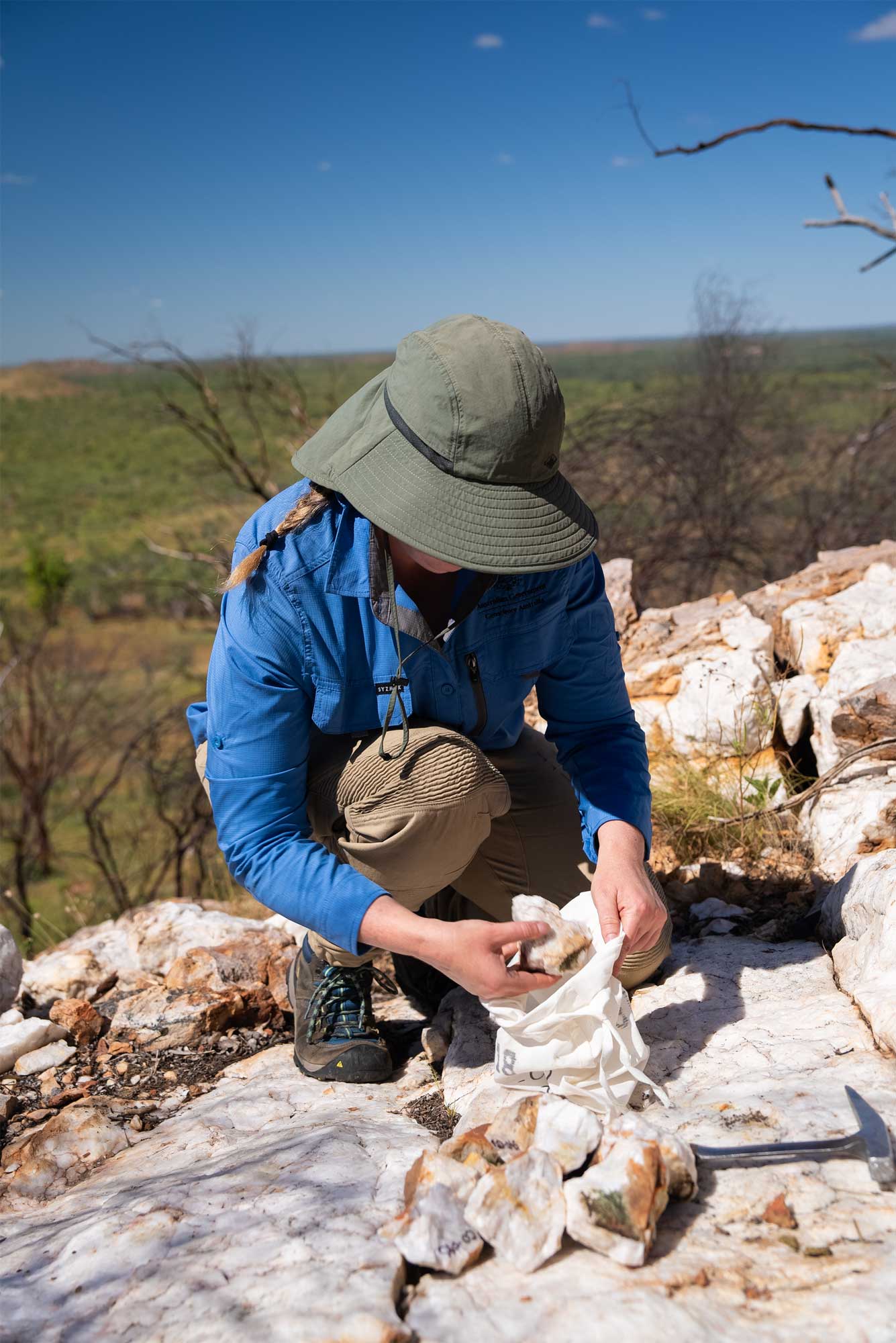
Geologist in the Mount Isa Cloncurry region, Queensland sampling quartz. Quartz is the second most abundant mineral in the Earth’s crust. (Image Source: Geoscience Australia)
Did you know that more than one half of all components in a mobile phone are made from minerals?
We live in an amazing world with phones, computers, advanced medicine, and electric cars. To create this modern technology, we rely on a wide variety of elements (like aluminium) and minerals (such as bauxite) that come from rocks in the Earth.
Elements like lithium, cobalt, and rare earths are vital for clean energy technologies—like solar panels, wind turbines, and batteries.
We identify these minerals and elements as Critical Minerals and Strategic Materials, due to their importance and the risk that their supply chains could become disrupted. Without them we would not be able to enjoy any of these advanced technologies that we use in our daily lives.
Our geoscientists work across multiple disciplines and programs using Earth science to map under cover and under explored areas to help locate these minerals and elements and provide advice to enhance exploration and diversify supply chains.
Learn about why critical minerals and strategic materials matter
Our Director of Mineral Resources Advice and Promotion Allison Britt and our Principal Science Advisor Dr Karol Czarnota and introduce us to critical minerals and strategic materials. (Source: Geoscience Australia YouTube).
Did you know that groundwater from natural mineral springs is bottled and sold throughout the country and is also used to make popular soft drinks?
Over millennia, water is absorbed into the ground filling up pores of rocks beneath the Earth’s surface, like a giant natural sponge, creating groundwater.
Groundwater is among our most precious resources. It is an important source of water for drinking, agriculture, and industry. It is particularly important in rural and remote parts of Australia, where rainfall is too infrequent or inadequate to reliably meet the water needs of a region. In the last few decades, we have more than doubled our groundwater use. Today, groundwater accounts for around one third of Australia's total water consumption.
To put this into perspective, most of the freshwater used across northern Australia comes from groundwater rather than from surface water sources which are less accessible.
Earth science allows us to use tools like satellite imagery, field sampling, data acquisition and modelling to map and monitor groundwater to ensure it’s used sustainably and managed responsibly. This type of Earth science is called hydrogeology.
Hydrogeologists spend their time sampling, analysing and assessing groundwater in areas across the country.
The geological regions that hydrogeologists look at for groundwater resources are called basins. Basins are a geological region in the subsurface that typically host sedimentary layers of sediments and rocks, such as sandstone, and vary in size and depth. Sandstone can be an aquifer (a rock that has the capacity to hold liquids) and therefore a potential source of groundwater.
The largest and most significant groundwater basin in Australia is the Great Artesian Basin, which spans across 22% of Australia covering over more than 1.7 million square kilometres.
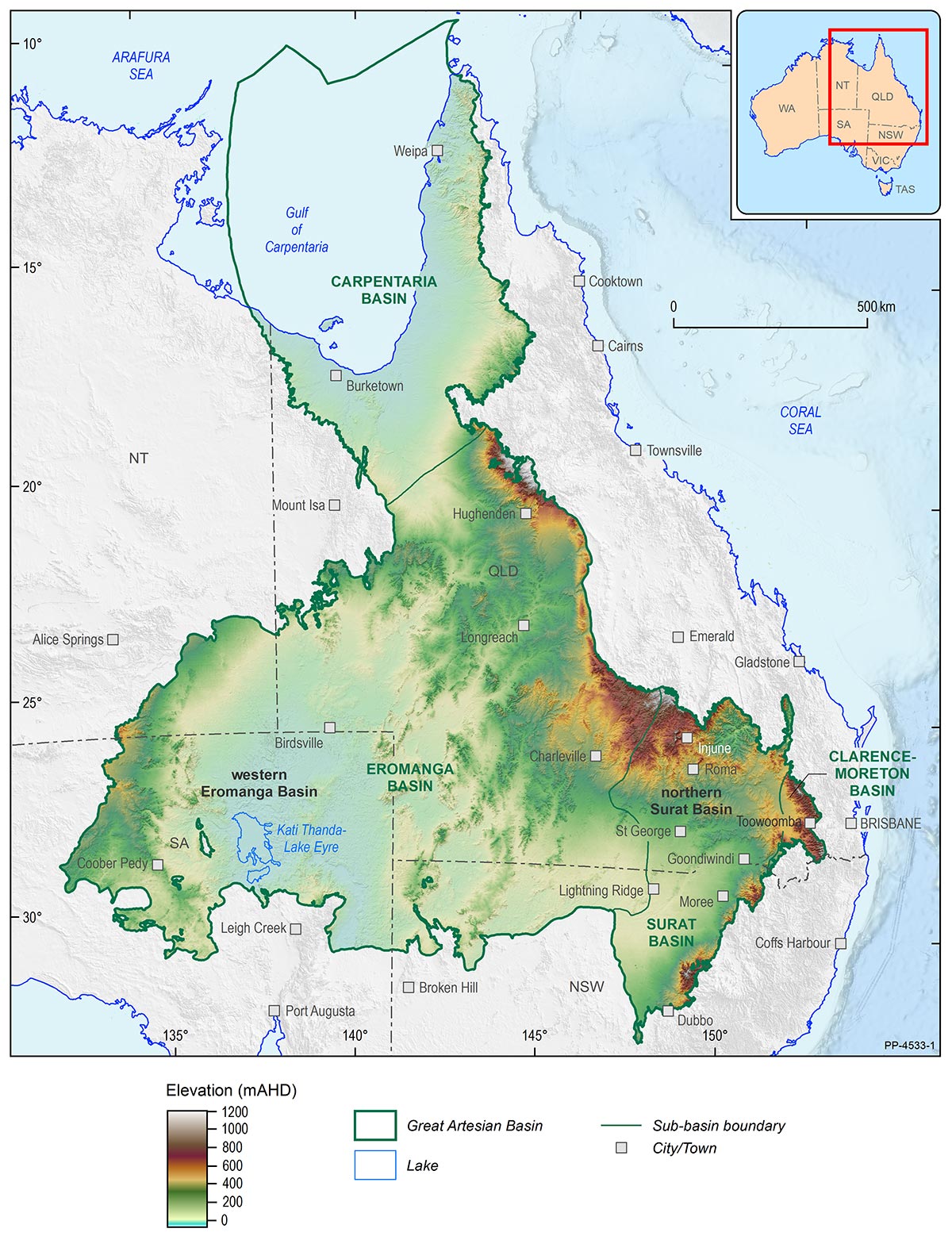
Location of northern Surat Basin and western Eromanga Basin pilot study areas within the Great Artesian Basin (Image Source: https://www.ga.gov.au/scientific-topics/water/groundwater/gab/assessing-the-status-of-groundwater-in-the-great-artesian-basin)
Before groundwater is extracted it needs to be characterised to understand how it can be used and where it is a rechargeable or a finite resource. A range of tools are available to assess groundwater resources, which can be grouped into two broad categories: desktop and field based.
Choosing the appropriate method to assess groundwater resources depends on the local conditions and the objectives of the assessment. Methods which can be used to assess the nature and characteristics of groundwater resources include:
- drilling
- hydrogeological mapping
- hydrochemical analyses
- groundwater modelling
- remote sensing techniques.
Learn how groundwater sampling is conducted!
This animation includes a simplified view of what groundwater sampling equipment looks like, what the equipment measures, and how scientists use the data. (Source: Geoscience Australia YouTube)
Did you know that hydrogen is a clean fuel that can be used to generate electricity that can power our cars, and heat our homes?
A secure supply of adequate, clean, reliable energy is vital for Australia’s economic growth and prosperity. Fortunately, Australia has an abundance of both non-renewable and renewable energy resources. Working towards a net zero future Australia is investing in cleaner energy options like hydrogen, solar and wind. Which are key to achieving net zero while keeping the lights on.
Our geoscientists work on continental-scale projects to evaluate the potential for energy resources to support the transition to a low carbon economy.
An example of a renewable energy is hydrogen. A naturally occurring element that is abundant in the universe yet not freely available as a gas on Earth. It binds with oxygen to create water molecules (H20) and is extremely hard to find in its pure form.
As a gas, hydrogen is considered a clean fuel source and a potential key player in reducing CO2 emissions. Unlike fossil fuels that emit carbon dioxide when combusted, combustion of hydrogen emits only water vapour, offering a potential pathway to decarbonise industry and transport. Hydrogen in its gaseous state is versatile. Energy created from using the gas can be used to heat a home or power a car and can also contribute to creating greener resources from emerging industries such as green steel.
As pure hydrogen gas is scarce across the globe, Earth science allows us to identify areas where hydrogen production would be most efficient and how geoscientists can improve the methods used to extract it.
The cheapest, safest and most efficient way of storing hydrogen is in thick salt caverns or depleted gas fields underground. Underground storage can hold larger volumes of hydrogen compared to that of a tank or container. Caverns can range from roughly 60 metres in diameter to 200 metres in length and act like a giant fuel tank stored under pressure.
A single large salt cavern could provide the same amount of energy storage as Snowy Hydro 2.0 with multiple caverns this size possible in the same area.
Australia is currently exploring the potential for suitable sites for underground storage. Using Earth science, we’ve uncovered potential for the development of multiple caverns underground in salt deposits across the Canning Basin in Western Australia, the Adavale Basin in Queensland and the offshore Polda Basin in South Australia.
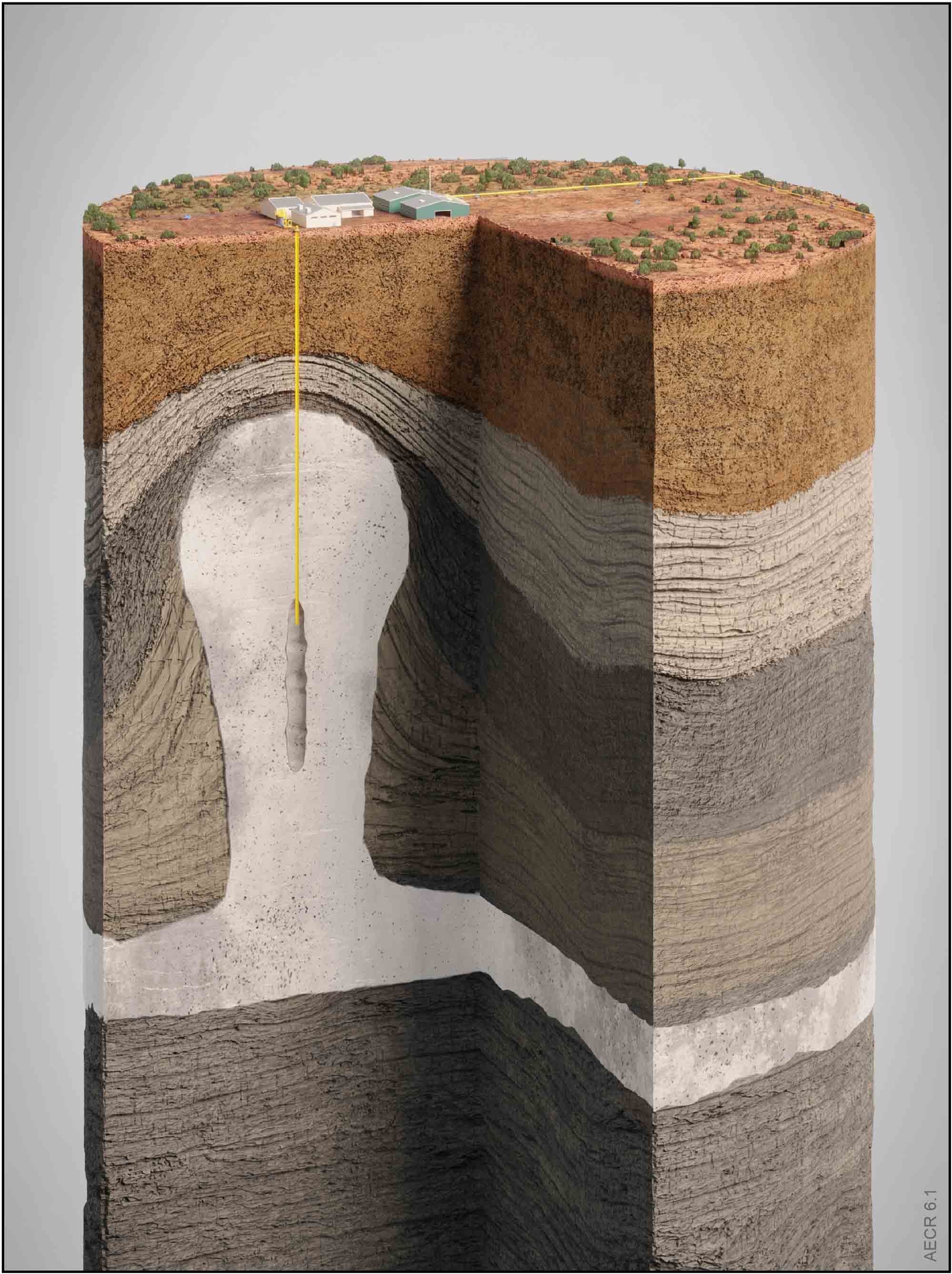
This model shows a typical configuration of an underground salt cavern which can be used for hydrogen storage. This salt cavern is created by injecting water into a thick underground accumulation of salt rock and dissolving out the salt over a period of years. For underground hydrogen storage, the salt rock must be predominantly halite (ie salt (sodium chloride)) with small amounts of non-salt inclusions. (Image Source: Geoscience Australia)
Careers in Earth Science: Career opportunities to grab and jump in with both feet!
If you love a good puzzle and are curious about how the Earth formed, why volcanoes and earthquakes happen or want to work outdoors or with lots of data, a career in Earth Science is for you!
You can find something that applies all aspects of Science, Technology, Engineering and Mathematics in Earth science. Follow one of these paths or do a little bit of everything as a:
- Geologist
- Geophysics
- Hydrogeologist
- Geochemist
- Geobiologist
- Geospatial analysist
- Palaeontologist
- Lab technician
- Field technician or fieldwork assistant
Just to name a few!
Whether you're passionate about technology, the environment, data, or how the Earth changes, there's a path for you in this exciting field.
Wondering what to study? Check out our flyer ‘What on Earth is a career in geoscience?’. It’s packed with info to help you find the right course and career path – no matter where your interests lie.
Meet Kristina Anastasi – Branch Head and Chair of the Resourcing Australia’s Prosperity initiative and one of our Branch Heads who helps put Geoscience Australia on the map

Kristina Anastasi, Branch Head and Chair of the Resourcing Australia’s Prosperity initiative in her office at the Geoscience Australia headquarters (Image Source: Geoscience Australia).
Understanding Australia’s resources allows us to paint a picture of what lies beneath our Earth’s surface. While our data provides insights into what this looks like, a key part of our work is providing evidence-based advice backed by these findings to help inform exploration, policy and investment decisions. Kristina and her team navigate the ways of providing technical advice about Australia’s resources to a variety of stakeholders. We sat down and had a chat with Kristina to learn more about her work and how she got into this field – as a non-scientist.
What does a day in the life of a Branch Head look like?
My day starts by having breakfast, coffee, and watching the Today Show. I decide whether to lock the dog outside or cage off the lounge area as he lost his privileges to that area while no one is home given his liking for chewing the rug. I go to work, check my emails if I haven’t already seen anything urgent over my coffee, and then prioritise tasks. Today I have been focussed on supporting the development of our Geoscience Australia Senate Estimates briefings.
While I’m working on my tasks, I usually keep my door open as there is always something that pops up and I like being available for my team. After work I go home and avoid taking my computer with me unless necessary. I cook dinner, watch The Block (which I’m trying to convince my kids to go on) or Netflix and spend time with my family.
What/Who inspired you to pursue a career in geoscience?
In my days working at the Department of Industry, Science and Resources I worked across multiple policy disciplines, such as offshore energy and minerals, and had the pleasure of engaging with people from Geoscience Australia quite regularly. Through this work I got to know staff from Geoscience Australia quite well and loved their passion, as well as the impact they were making through their work.
For me, coming into Geoscience Australia wasn't just about the science; it was about the evidence. It was about demonstrating why a decision was good and showing the benefits. Showing why our work matters to support evidence-based policy and decision-making that has an impact. That’s what inspired me.
What did your pathway to your career look like?
I came from a social welfare background in a Non-Governmental Organisation (NGO). I entered the public service as an APS5, in an area focused on housing policy. Over my time in federal government, I've had the opportunity to move across different areas. From housing, I moved into industry policy and got to understand various sectors, gravitating towards strong industry sectors like defence and resources.
I was drawn to these sectors due to the strategic aspect. Looking forward, looking out and seeing how this work influenced change. It wasn’t just about the immediate fix for it was about understanding the longer-term impacts – the why we were doing it and more importantly having policy and decision-making being underpinned by evidence. That’s what led me to working for Geoscience Australia and across various roles, to where I am today. Leading and establishing the frameworks to underpin the successful delivery of Resourcing Australia’s Prosperity initiative as a Branch Head and Chair of the Operations Committee.
What is the best part of your job?
Providing advice and (hopefully) playing even a small role in influencing government on its resource polices and implementation – through geoscience. We are part of a bigger picture that is influencing change and seeing new industries come up.
I also really enjoy working with the people here who are really smart (I have a lot of people around me whose name starts with ‘Dr’). Learning new things from them, being part of their journey and supporting their career paths. Being an applied science agency, I enjoy helping our geoscientists see how their work influences and provides value to Australians through them being a public servant.
What advice would you give someone who wants to pursue a career in STEM?
Someone once told me that people have three careers in their lifetime. I think everyone's career can be driven by their passions and what they find they are good at. Whether you've come out of an environmental background, an analytical background, or a particular expertise, you will find your path as your passions evolve.
For the kids! Download our Minecraft posters
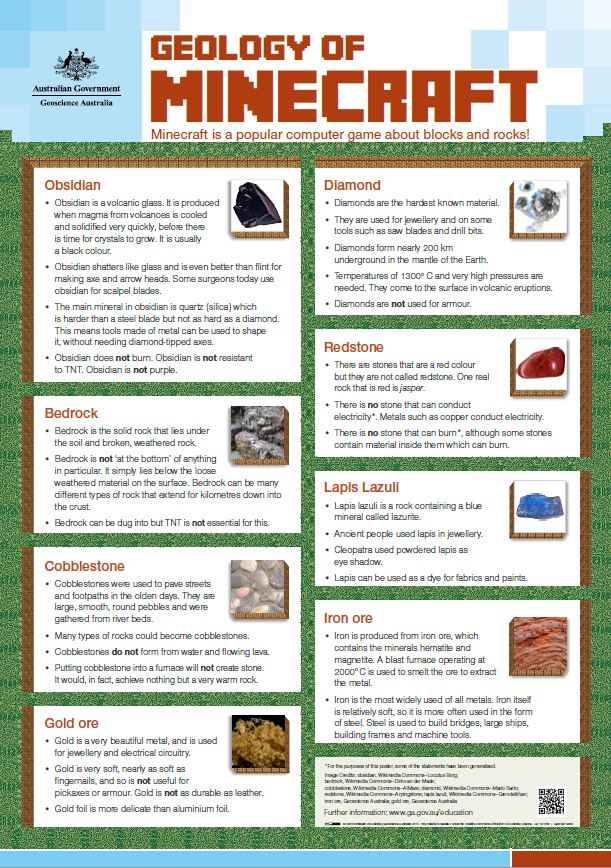
Minecraft is a popular computer game about rocks and how to get resources for housing and to make tools. Our two Minecraft posters are a fun way for kids to learn about the geology of the rocks and minerals that they use when playing this game.
Be sure to download poster one and poster two!