Australian Mineral Exploration Review 2025 Appendices
Page last updated:3 August 2026
Appendix A. Glossary
Alloy
a metallic material made by combining two or more elements, at least one of which is a metal, to improve properties such as strength, hardness, corrosion resistance or workability.
Base Metals
includes copper, lead, nickel and zinc.
By-product
a secondary mineral or element that occurs within a deposit being mined primarily for another commodity, and which may be recovered during mining, processing or refining if technically and economically viable.
Company Ticker
is a unique, short abbreviation of letters (and sometimes including numbers) used to identify a publicly traded company on a stock exchange. It functions like a stock’s shorthand name tag so investors can quickly look up prices or place buy and sell orders without writing out the full corporate name.
Contained Material
the amount of economic material in a deposit. Contained Material can be estimated my multiplying the tonnage and grade of the deposit.
Critical Minerals
are minerals or elements that are essential to modern technologies, economies and national security, and are vulnerable to supply chain disruption. The commodities included on Australia’s Critical Minerals List also align with Australia’s priority technologies, have geological resource potential in Australia and are in demand from strategic international partners,
Demonstrated Resource
a collective term for the sum of Measured and Indicated Resources, including Proved and Probable Ore Reserves.
Deposit
a mass of naturally occurring material in the Earth that contains an anomalous concentration of some mineral or rock type that has some potential for human utilisation, without regard to mode of origin. Typically, a single, connected, genetically related body of material.
Downstream Processing
the refining, chemical processing and other value-adding steps that occur after mineral extraction and initial concentration, converting mineral feedstocks into high-purity materials, intermediate products or components suitable for manufacturing and end-use applications.
Drilling Purpose
dictates the reasoning and specific objectives behind drilling a particular hole in an exploration or mining program. The JORC Code requires companies to explicitly state why a hole was drilled to provide transparent, unbiased information to investors. Purposes include:
Extension drilling – undertaken at a deposit with an existing Mineral Resource to test the continuation of known mineralisation along strike, down dip or at depth, with the objective of adding to or extending the existing Mineral Resource estimation for the deposit.
First-pass drilling – initial drilling at an exploration project with no Mineral Resource, undertaken to test a target or mineralisation concept and generate Exploration Results that may inform whether further work is warranted.
Follow-up drilling – additional early-stage drilling at an exploration project with no Mineral Resource, designed to clarify, verify or expand on previous Exploration Results before sufficient data exist to estimate a Mineral Resource.
Infill drilling – drilling within the known mineralised envelope of a deposit with a Mineral Resource, undertaken at closer spacing to improve geological confidence and support conversion of Mineral Resources from Inferred to Indicated and/or Measured, or Indicated to Measured, including supporting the conversion of Indicated or Measured Mineral Resources to Ore Reserves.
Step-out drilling – drilling undertaken in a new location proximal to a deposit with a Mineral Resource, but outside the existing deposit envelope, to test whether nearby mineralisation or interpreted extensions may represent additional resource potential.
Economic Demonstrated Resource (EDR)
a Demonstrated Resource that is regarded as economic, implying that, at the time of determination, profitable extraction or production under defined investment assumptions has been established, analytically demonstrated, or assumed with reasonable certainty. The EDR category provides a long-term view of what is likely to be available for mining. It does not include Inferred Resources which do not have enough geological confidence to support mine planning.
Existing Deposit Exploration
delineating or proving up an existing deposit through drilling, including extensions and infill, which has been classified as an Inferred Mineral Resource or higher. (ABS definition)
Exploration Results
include data and information generated by mineral exploration programmes that might be of use to investors but which do not form part of a declaration of Mineral Resources or Ore Reserves.
Exploration Stage
refers to the stage of drilling and includes 3 categories in this publication: Early Stage, Resource Expansion and Resource Upgrade.
Early-stage – refers to first-pass or follow-up drilling without a Mineral Resource estimate.
Resource Expansion – refers to step-out or extensional drilling at a deposit with a Mineral Resource estimate.
Resource Upgrade – refers to infill drilling at a deposit with a Mineral Resource estimate.
Grade
the concentration or quantity of a commodity within mineralised material, commonly reported as a percentage, grams per tonne, or parts per million, depending on the commodity.
Intercept
an interval of rock cut (or intercepted) by a drill hole that contains the mineralisation or geology of interest. An intercept contains the length of the mineralised intercept, the grade of the mineralisation, the commodity being reported and the depth at which the intercept begins.
Maiden Mineral Resource
the first report of a Mineral Resource estimate for a distinct deposit or commodity (see Appendix E).
Deposit Maiden Mineral Resource – the first report of a Mineral Resource estimate for a distinct deposit or commodity by deposit. (Appendix E).
Project Maiden Mineral Resource –the first report of a Mineral Resource estimate for a distinct deposit or commodity by project. (Appendix E).
Microalloy
an alloy containing very small additions of elements, such as niobium, vanadium or titanium, that significantly improve properties like strength, toughness or grain refinement.
Mineral Exploration Expenditure
covers all expenditure (capitalised and non-capitalised) during the exploratory or evaluation stages in Australia and Australian waters. Costs include cost of exploration, determination of recoverable reserves, engineering and economic feasibility studies, procurement of finance, gaining access to reserves, construction of pilot plants and all technical and administrative overheads directly associated with these functions. Examples are costs of satellite imagery, airborne and seismic surveys, use of geophysical and other instruments, geochemical surveys and map preparation; licence fees, land access and legal costs; geologist inspections, chemical analysis and payments to employees and contractors.
Mineral Resource
a concentration or occurrence of solid material of economic interest in or on the Earth’s crust in such form, grade (or quality), and quantity that there are reasonable prospects for eventual economic extraction. The location, quantity, grade (or quality), continuity and other geological characteristics of a Mineral Resource are known, estimated or interpreted from specific geological evidence and knowledge, including sampling. Mineral Resources are sub-divided, in order of increasing geological confidence, into Inferred, Indicated and Measured categories.
Inferred Mineral Resource – part of a Mineral Resource for which quantity and grade (or quality) are estimated based on limited geological evidence and sampling. Geological evidence is sufficient to imply but not verify geological and grade (or quality) continuity. It is based on exploration, sampling and testing information gathered through appropriate techniques from locations such as outcrops, trenches, pits, workings and drill holes.
Indicated Mineral Resource – part of a Mineral Resource for which quantity, grade (or quality), densities, shape and physical characteristics are estimated with sufficient confidence to allow the application of Modifying Factors in sufficient detail to support mine planning and evaluation of the economic viability of the deposit.
Measured Mineral Resource – part of a Mineral Resource for which quantity, grade (or quality), densities, shape, and physical characteristics are estimated with confidence sufficient to allow the application of Modifying Factors to support detailed mine planning and final evaluation of the economic viability of the deposit.
Mineralisation
the natural concentration of minerals or elements in rock, sediment or regolith, formed by geological processes. Mineralisation may contain commodities of economic interest but does not necessarily imply that the material is economically extractable or classified as a Mineral Resource.
New Deposit Exploration
exploration on previously unknown mineralisation or known mineralisation yet to be classified as a Mineral Resource. They include exploration: resulting in finding mineralisation that was previously unknown; on previously known mineralisation that has not been subjected to modern exploration; within an existing mining tenement for the purpose of finding new sources of mineralisation that have not already been classified at least as an Inferred Mineral Resource. (ABS definition)
Platinum Group Elements (PGEs)
are six noble metals, platinum, palladium, rhodium, iridium, osmium, and ruthenium, valued for their rarity, catalytic properties, and resistance to corrosion. Depending on the definition PGEs can also be classified as precious metals.
Polymetallic
ores or deposits that contain multiple different metallic elements in concentrations high enough to be commercially valuable. The term is most widely used in geology and mining to describe complex ores (such as those containing lead, zinc, copper, silver and gold).
Precious Metals
includes gold and silver and are rare, naturally occurring metallic elements of high economic value.
Primary Commodity
the main mineral or element of economic interest in a deposit, project or exploration result. It is the commodity that is the principal focus of exploration, resource estimation and potential extraction.
Processing
the physical or chemical treatment of mined material or mineral concentrates to separate, upgrade or transform them into materials suitable for refining, manufacturing or use.
Project
a geographically, administratively or economically defined area of mineral exploration, resource definition or mine development activity. A project may comprise one or more deposits, prospects, mineralised occurrences, targets, tenements or mining areas that are grouped for the purposes of exploration, evaluation, reporting, development or management. Unlike a deposit, a project does not need to represent a single connected or genetically related body of mineralisation.
Prospect
a geographically defined area or target where geological, geochemical, geophysical or drilling information indicates potential for mineralisation, but where there may not yet be enough information to estimate a Mineral Resource. In exploration reporting, a prospect is commonly treated as a specific location with a broader project or tenement that warrants further exploration.
Rare Earth Elements (REE)
comprise the 15 lanthanide elements plus yttrium, which shares similar chemical properties. The lanthanides are lanthanum, cerium, praseodymium, neodymium, promethium, samarium, europium, gadolinium, terbium, dysprosium, holmium, erbium, thulium, ytterbium, and lutetium.
Refining
the process of removing impurities from mineral concentrates or other feedstocks to produce a higher-purity material suitable for further processing, manufacturing or use.
Significant Drill Results
selected mineral exploration drilling intercepts that indicate notable mineralisation based on factors such as grade, interval length, depth, commodity type and geological context, and that may help demonstrate the mineral potential of a project, support a new discovery, or guide further exploration. For this publication, these are based on selected headline reported results by the companies.
Strategic Materials
are minerals or elements that are important to the global transition to net zero, broader strategic applications, align with Australia’s priority technologies, have geological resource potential in Australia, and are in demand from strategic international partners, but whose supply chains are not currently vulnerable enough to be classified as critical minerals.
Superalloy
a high-performance alloy, usually based on nickel, cobalt or iron, designed to retain exceptional strength, corrosion resistance and stability at high temperatures.
Tenement
A legally granted land area, licence or permit that gives its holder rights to undertake mineral exploration, evaluation or mining activities, subject to relevant legislation and approval conditions.
Appendix B. Australian Critical Minerals Map
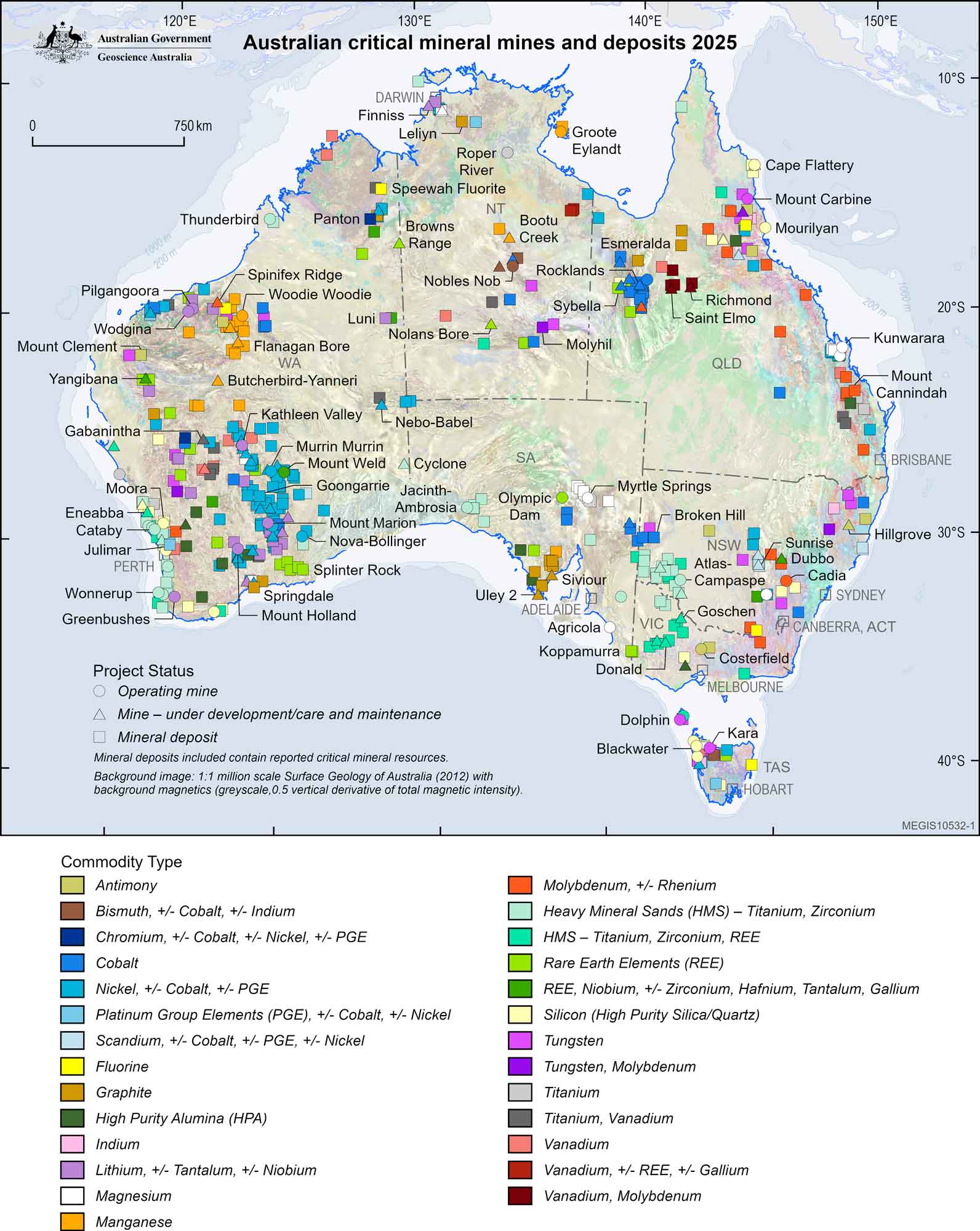
This map shows the locations and status of Australian operating mines, mines under development, mines on care and maintenance and mineral deposits associated with a critical mineral resource in 2025.
Appendix C. Australian Operating Mines Map
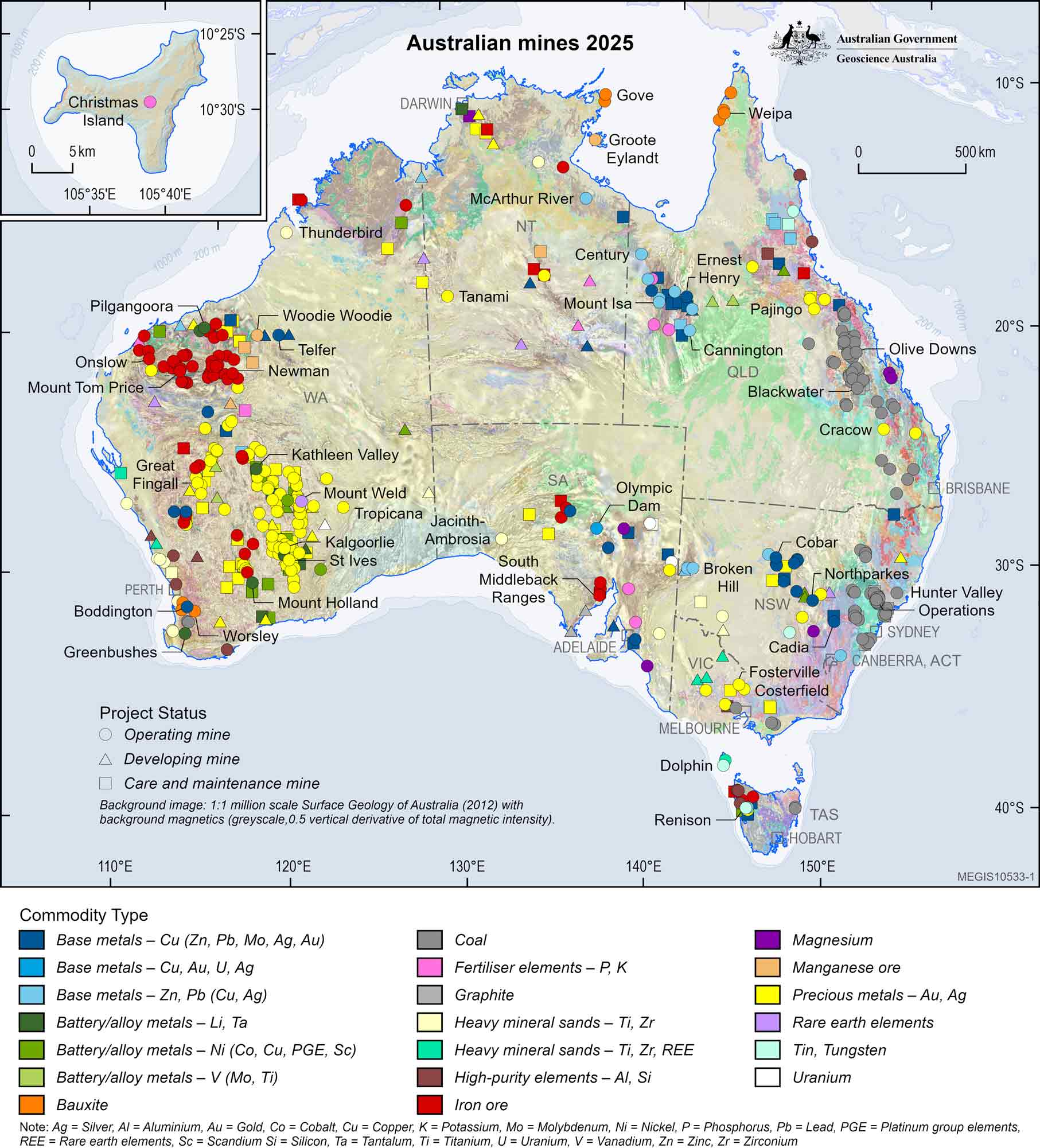
This map shows the location and status of Australian operating mines, mines under development and mines under care and maintenance as of December 2025.
Appendix D. Additional time series charts of Australian mineral exploration expenditure
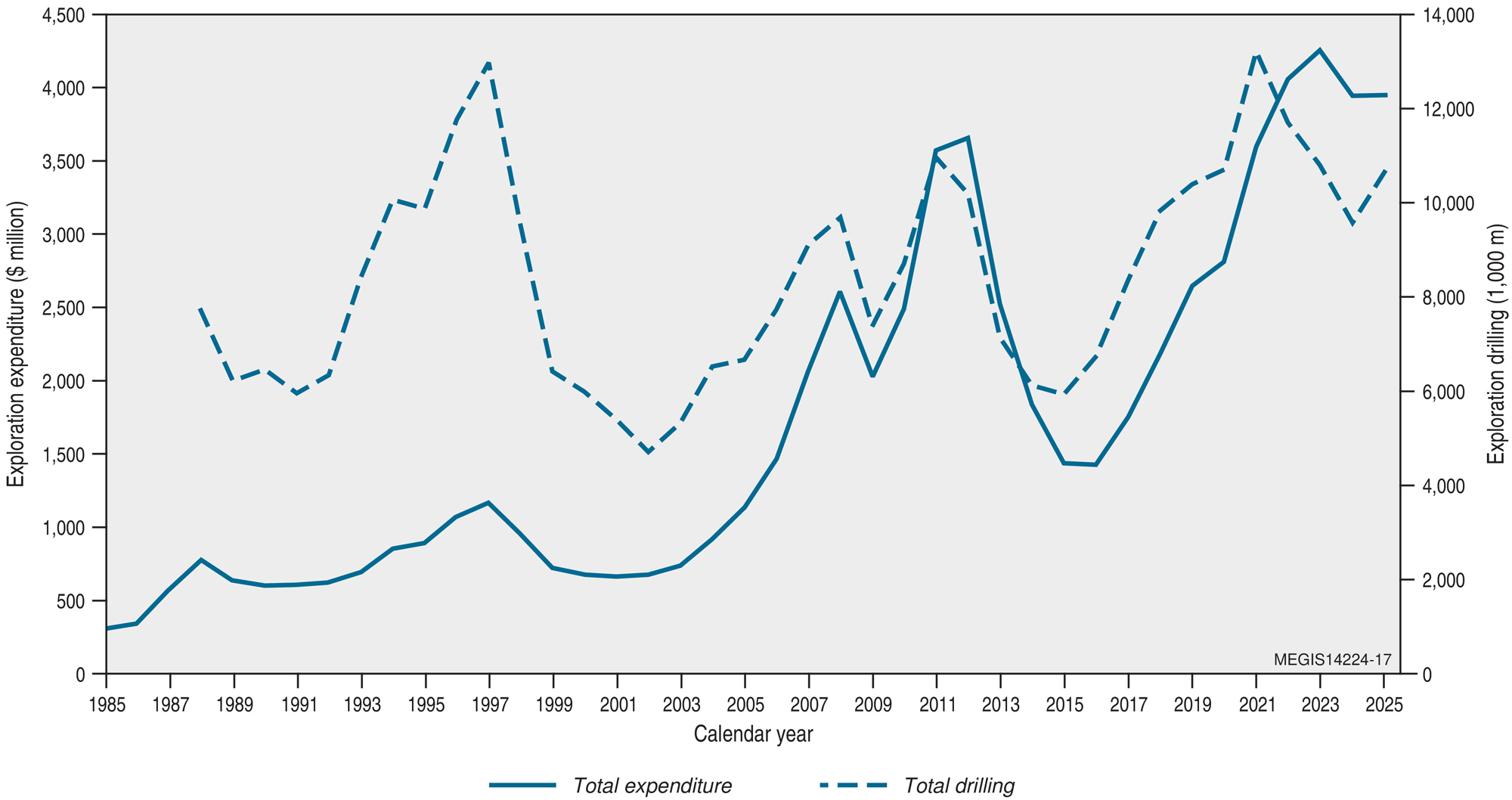
Figure 17. Total mineral exploration expenditure and drilling by calendar year, 1985–2025. Data from Australian Bureau of Statistics, Mineral and Petroleum Exploration, Australia, Table 2.
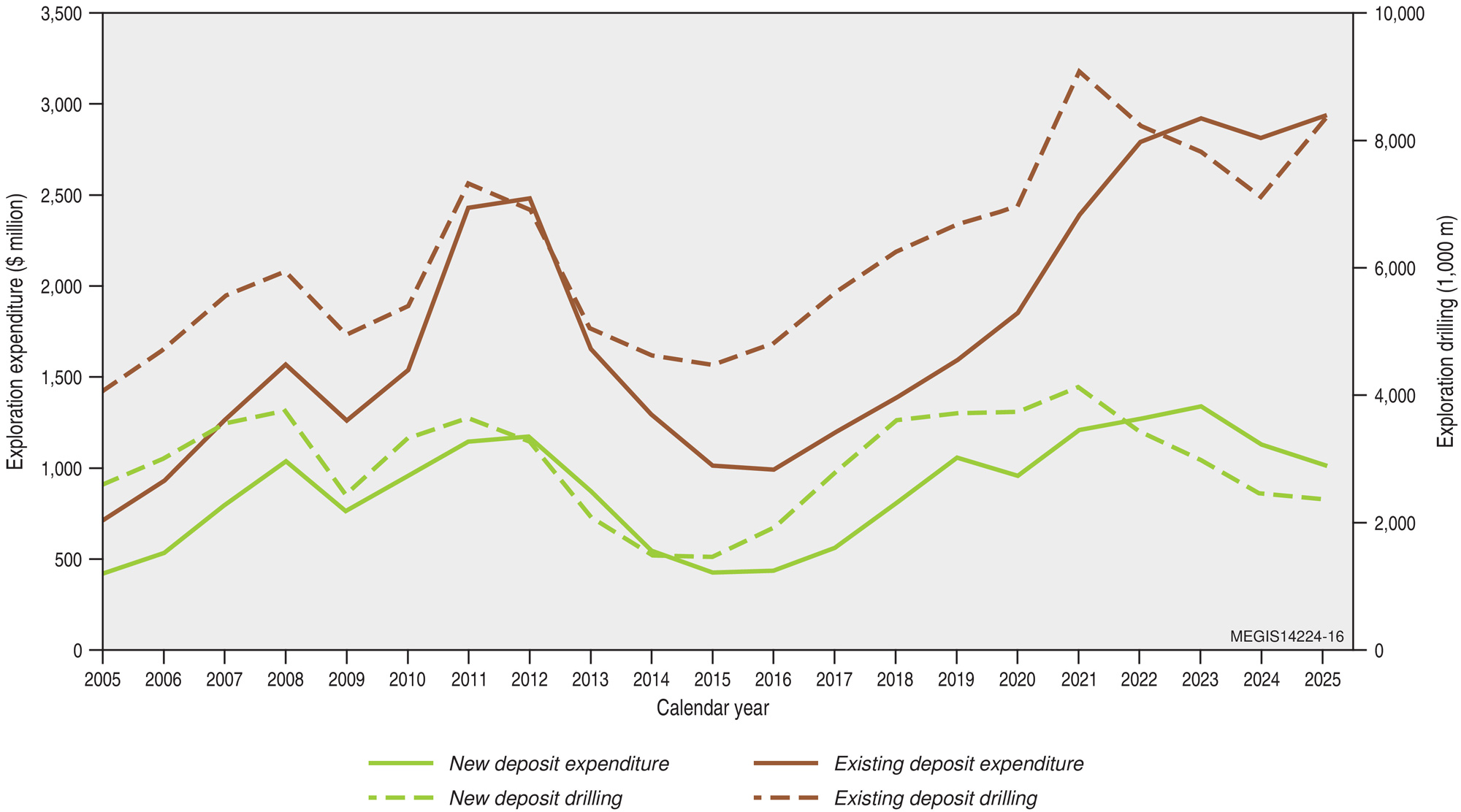
Figure 18. New deposit and existing deposit mineral exploration expenditure and drilling by calendar, 2005–2025. Data from Australian Bureau of Statistics, Mineral and Petroleum Exploration, Australia, Table 2.
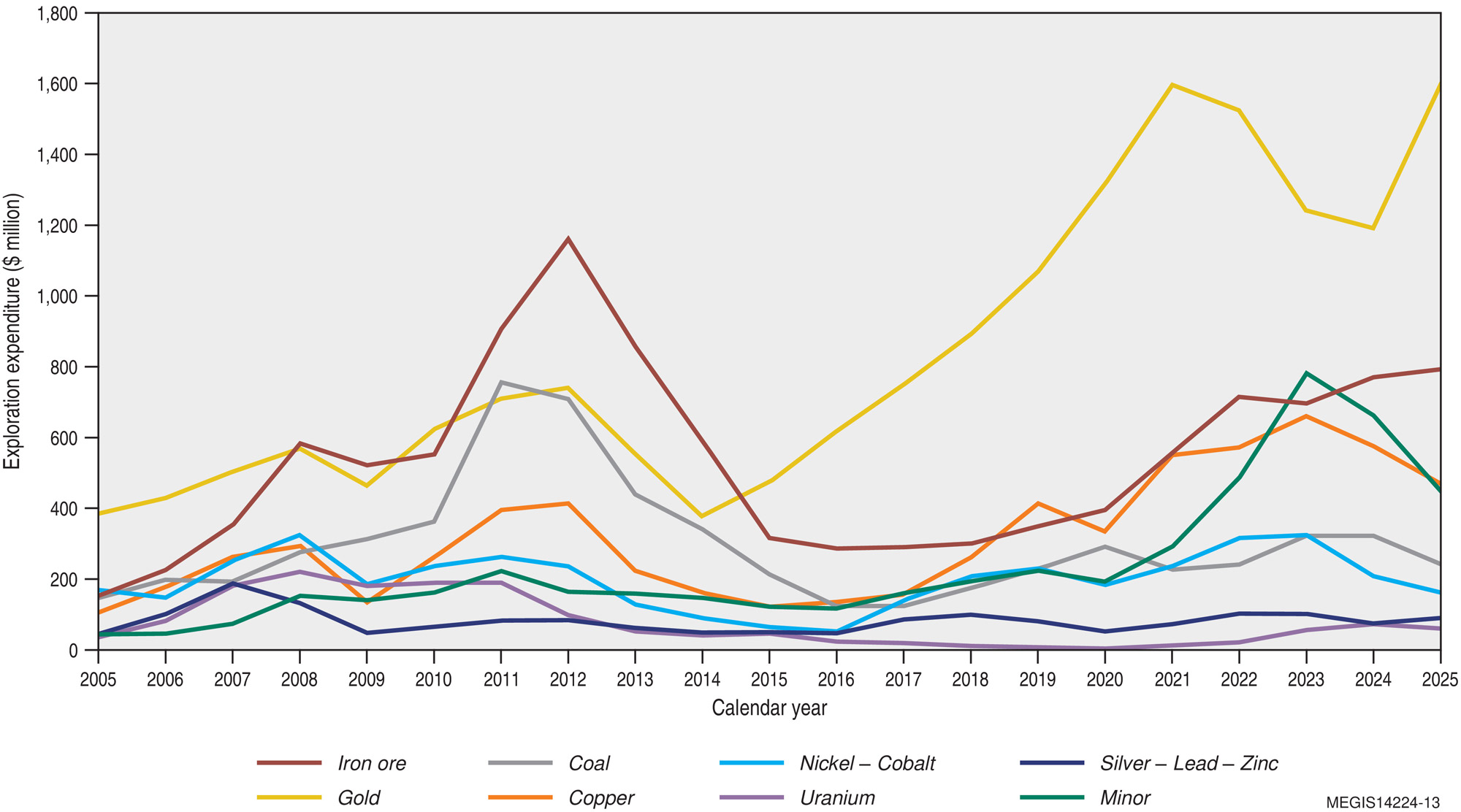
Figure 19. Mineral exploration expenditure by commodity, 2005–2025. Data from Australian Bureau of Statistics, Mineral and Petroleum Exploration, Australia, Table 5
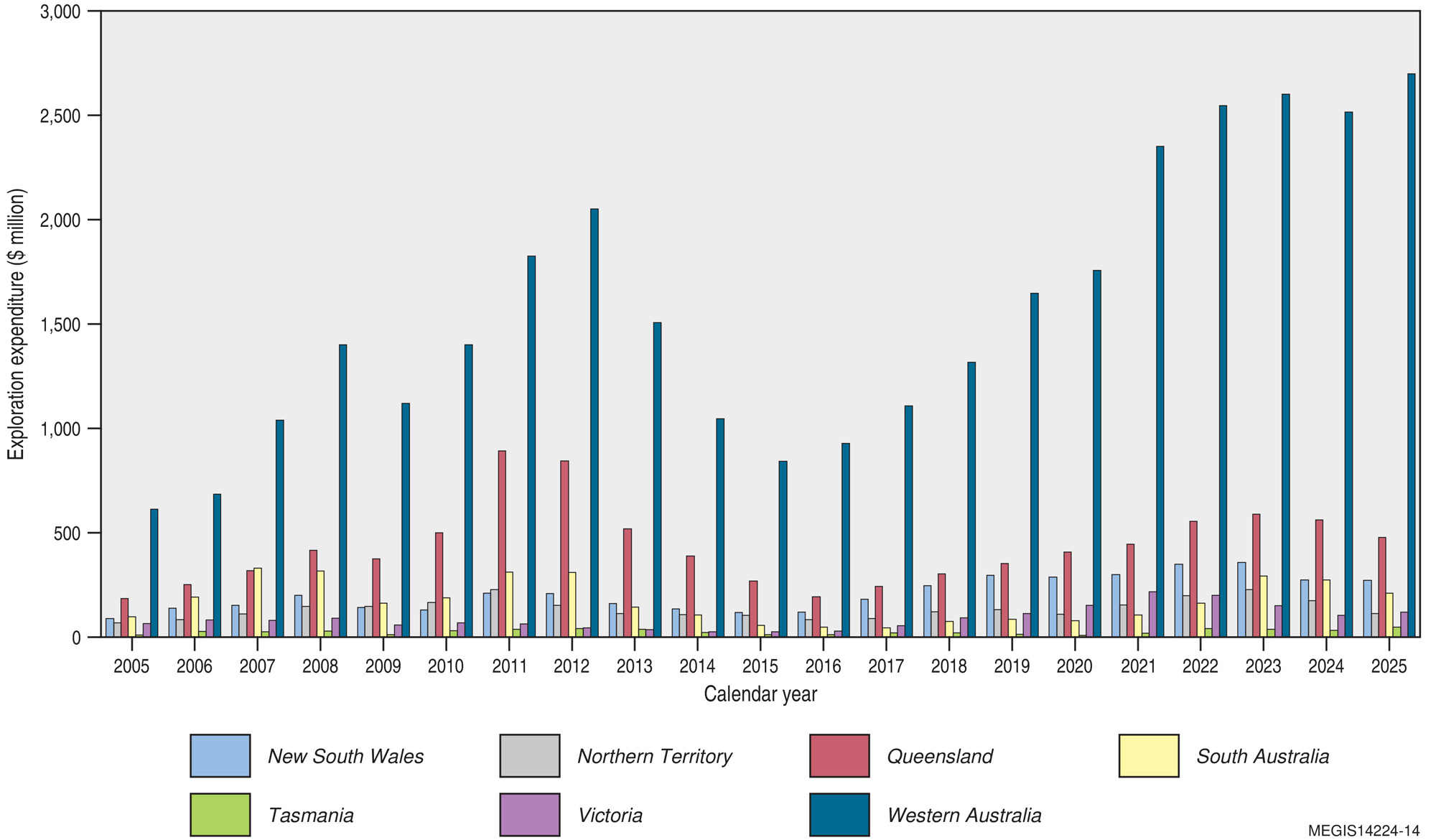
Figure 20. Mineral exploration expenditure by jurisdiction, 2005–2025. Data from Australian Bureau of Statistics, Mineral and Petroleum Exploration, Australia, Table 4.
Appendix E. maiden Mineral Resource criteria
A maiden Mineral Resource is the first reporting of a Mineral Resource estimate for a distinct deposit or commodity. These are usually reported in public announcements to stock exchanges such as the ASX and represent an important milestone for exploration projects, as they provide an initial estimate of the scale, grade and potential economic significance of a discovery. A maiden Mineral Resource has not had any prior Mineral Resource or Ore Reserves defined under a reporting code recognised by the Committee for Mineral Reserves International Reporting Standards72 (CRIRSCO) such as the JORC Code73.
A maiden Mineral Resource is defined as a Mineral Resource estimate for a deposit or commodity that:
- has not had any prior Mineral Resource or Ore Reserve defined for it under a CRIRSCO recognised reporting code
- is publicly reported by the company, including through a stock exchange such as the ASX, or Geoscience Australia has information on which it can report publicly
- may form part of an existing project but is a separate deposit
- may relate to a new commodity at an already defined deposit, where that commodity has not previously been reported as a Mineral Resource.
Mineral Resource estimates are not defined as maidens where:
- a Mineral Resource or Ore Reserve has previously been reported for the same deposit and commodity, including by a previous owner or another company
- the announcement only reports a new Mineral Resource classification category or Ore Reserve, such as a “Maiden Indicated Mineral Resource”, where an Inferred Mineral Resource has already been reported for the deposit
- the estimation relates to a new zone, extension, domain or mining method within an existing deposit that already has a reported Mineral Resource, for example a “Maiden Underground Resource” for the underground portion of an already defined deposit.
Maiden Mineral Resources can be defined at both the deposit and the project level.
72 Committee for Mineral Reserves International Reporting Standards. 2026. Promoting international best practicing in the reporting of Mineral Exploration, Mineral Resources and Mineral Reserves.
73 JORC, 2012. Australasian Code for Reporting of Exploration Results, Mineral Resources and Ore Reserves (The JORC Code).