Australian Mineral Exploration Review 2025 Introduction
Page last updated:3 August 2026
Geoscience Australia has delivered the Australian Mineral Exploration Review since 2009. It provides an analysis of the Australian exploration environment, highlighting the link between continued exploration, resource definition and resource extraction. The annual assessment of Australia’s exploration industry draws on data from the Australian Bureau of Statistics1 and company reporting to reveal exploration trends, activities and mineral discoveries from across Australia.
This edition of the Australian Mineral Exploration Review provides an overview of:
- exploration expenditure and metres drilled as collected and released by the Australian Bureau of Statistics
- maiden resource announcements released on the Australian Securities Exchange (ASX) and equivalent
- significant drilling results for critical minerals, strategic materials, precious metals and other commodities announced on the ASX and equivalent.
Technical and scientific terms are defined in the Glossary (Appendix A) and any acronyms and abbreviations used in this document are listed and defined in at the beginning of this review. The accompanying data tables are downloadable to enable enhanced accessibility and useability of the information provided in this review.
Precompetitive geoscience initiatives and critical mineral discovery
Australia has a rich and diverse mineral endowment and a long history of discovering high-quality mineral resources. Between 2017 and 2023, one in four world class mineral discoveries were made in Australia2. Despite this, much of the continent remains under-explored, and there is still considerable opportunity for the growth of Australia’s resources sector. To stimulate and support exploration and discovery in Australia, before private sector exploration and investment,federal, state and territory governments carry out precompetitive geoscience to support resource development.
Recently, precompetitive geoscience has concentrated on increasing the geological knowledge about critical minerals in Australia to further stimulate exploration in line with the Australian Government’s Critical Mineral Strategy3. Of the 79 elements that are sourced by mining globally, Australia produces 49, has reported mineral resources for 66 and active exploration for 71 (Figure 1). Australia lists 31 commodities as critical minerals along with 5 elements regarded as strategic materials (Figure 1)4. Further information about where critical mineral projects are being developed and explored for can be found on the Australian Critical Minerals Map (Appendix B)5. Whereas, the Australian Operating Mines Map (Appendix C) shows developing and operational mines extracting strategic materials, precious metals and other commodities, as well as critical minerals6.
Over the past decade, increasing our understanding of Australia's resource potential through precompetitive geoscience initiatives, such as the Exploring for the Future program, has helped companies raise investment for exploration, Resourcing Australia’s Prosperity will continue to do this into the future.
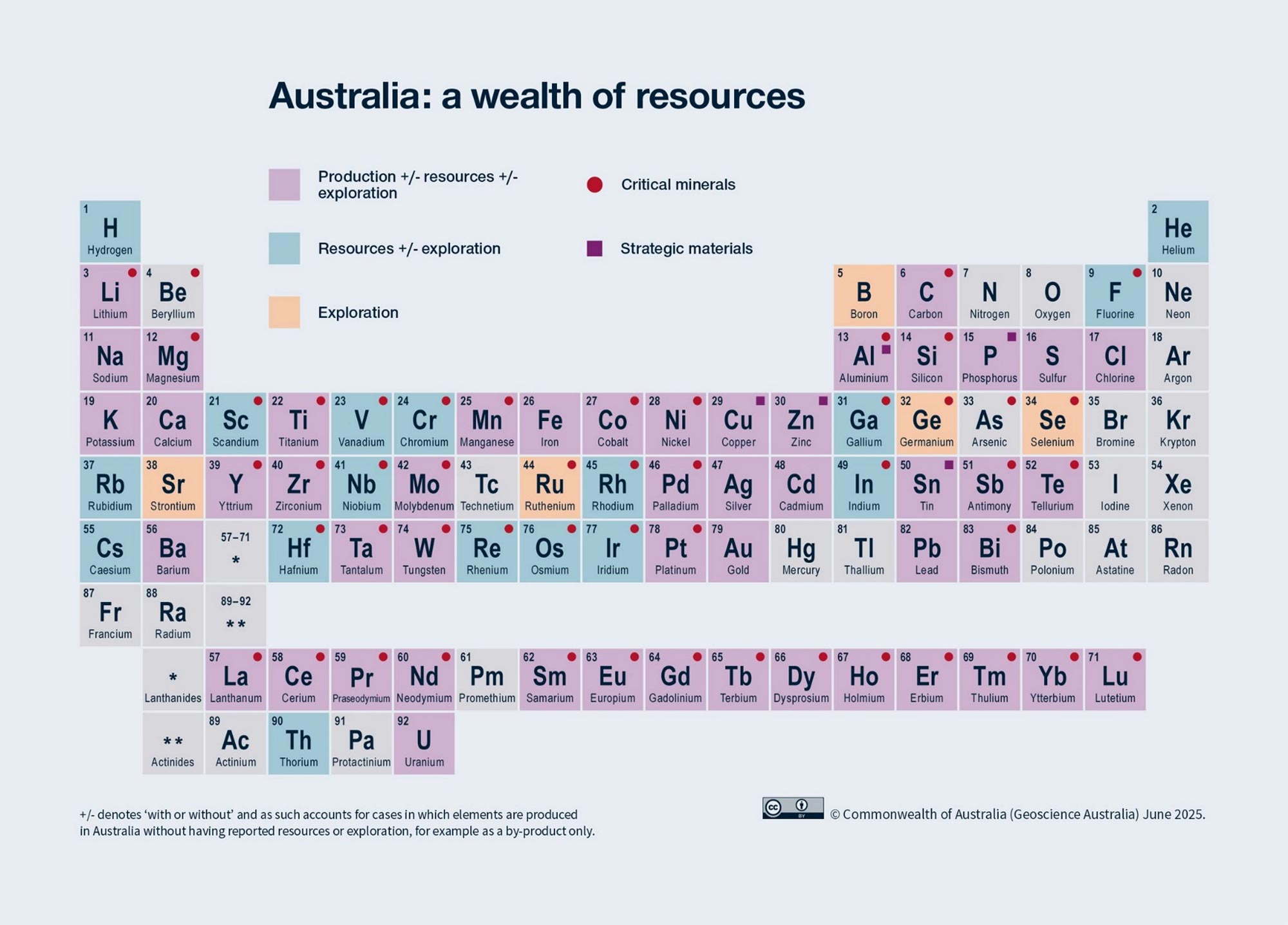
Figure 1. Periodic table of the elements showing commodities that are being produced, have reported Mineral Resources or are being explored for in Australia.
During the program, precompetitive data led to new mineral discoveries including an iron oxide copper-gold deposit near Tennant Creek, Northern Territory and four rare earth element (REE) resources in Western Australia, the Northern Territory and Queensland. Since 2017, precompetitive geoscience has supported the discovery of 7 of 10 world- class mineral deposits in Australia. This includes the giant Oak Dam discovery in South Australia, which drew on the continued development of a genetic model for iron-oxide-copper-gold deposits7.
Resourcing Australia’s Prosperity is the current Australian Government initiative to promote and accelerate mineral exploration and discovery through precompetitive geoscientific data and information. Under the Resourcing Australia’s Prosperity initiative, Geoscience Australia is using innovative data, research and analysis to assess national potential for a broad range of the resources critical to the net zero transition and supporting a strong and diverse resources sector. This includes mapping Australia’s potential for critical minerals and strategic materials, hydrogen and carbon storage, and offshore renewable energy. It will also map the groundwater systems that support the development of Australia’s natural resources, contribute to water and food security, and bolster climate resilience. By partnering with state and territory governments and research partners, Resourcing Australia’s Prosperity lays the groundwork for a prosperous, competitive and sustainable future8.
In 2025, as part of the research undertaken by the Australian Critical Minerals Research and Development Hub9, Geoscience Australia released the ‘Understanding Australia’s High Purity Silica Potential: A Global Mineral Systems Review’10. This publication discusses various components of silica mineral systems and their prospectivity for high-purity silica using the mineral systems framework and is an example of how the Australian Government is equipping mineral explorers with the knowledge to de-risk exploration.
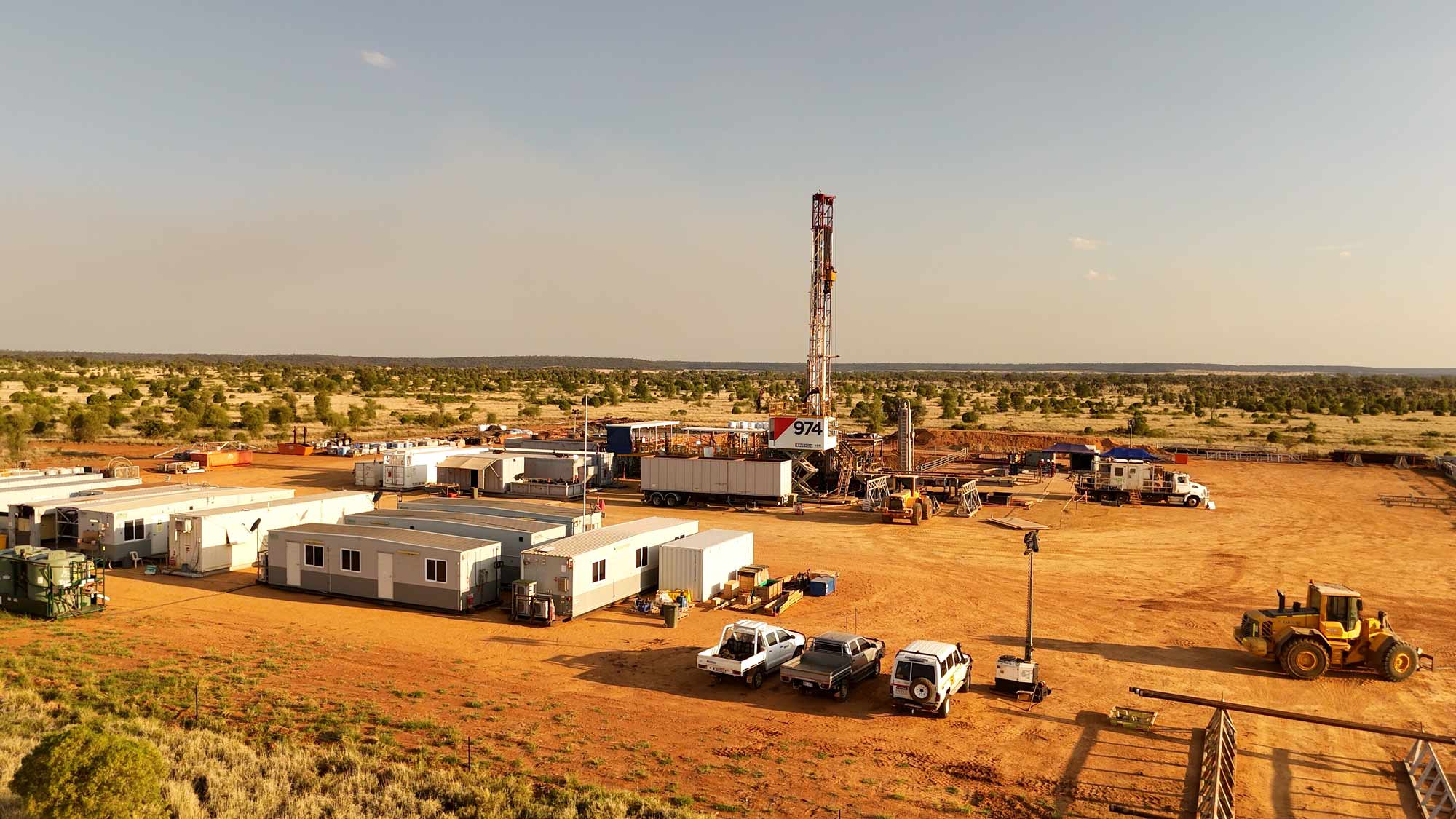
Geoscience Australia Enniskillen 1 stratigraphic drill site, central-west Queensland. Geoscience Australia assessed the Adavale Basin's geology and potential for resources and underground storage. The drilling campaign provides important new subsurface data from a deeply buried and underexplored basin, improving understanding of potential critical minerals and strategic materials, groundwater resource and salt deposits that may support future hydrogen storage opportunities. Image by James Cropper, Geoscience Australia.
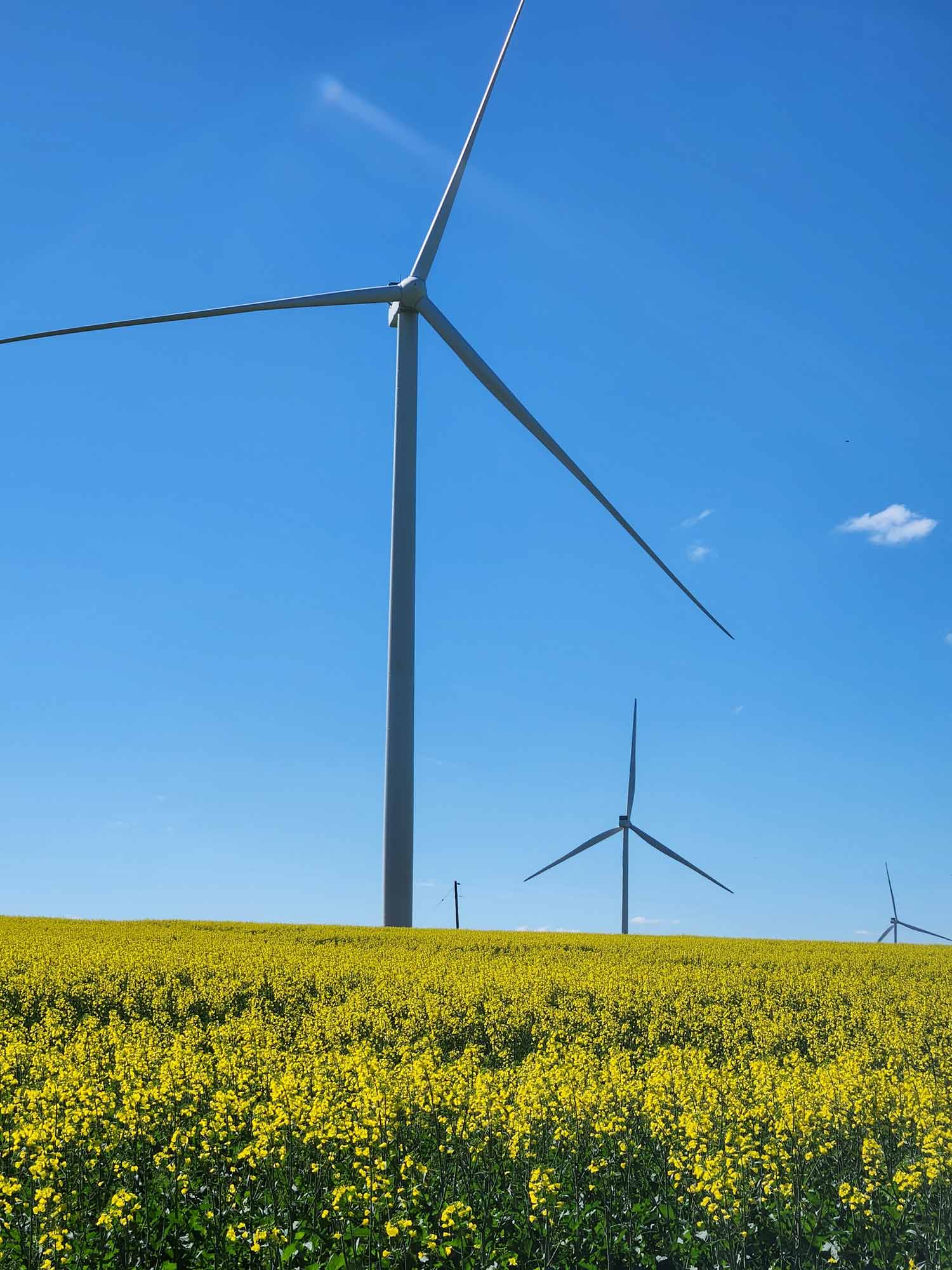
Wind turbines, like these in a canola field near Dandaragan in the Wheatbelt region of Western Australia, are an example of the need for Australia to secure critical minerals and strategic minerals. Diversifying and strengthening the supply chain will ensure the manufacturing of wind turbines and other green energy equipment. Image by Verity Normington, Geoscience Australia.
1 Australian Bureau of Statistics, 2025. Mineral and Petroleum Exploration Australia (December 2025).
2 Minex Consulting Pty Ltd, 2023. Exploration: Australia vs The World.
3 Department of Industry, Science and Resources, 2023. Critical Minerals Strategy 2023–2030.
4 Department of Industry Science and Resources, 2024. Australia’s Critical Minerals List and Strategic Materials List.
5 Pheeney, J., Kucka, C., Morfiadakis, A., 2026. Australian Critical Minerals Map 2025. Commonwealth of Australia (Geoscience Australia).
6 Pheeney, J., Kucka, C., Munns, C., 2026. Australian Operating Mines Map 2025. Commonwealth of Australia (Geoscience Australia).
7 Geoscience Australia, 2024. Exploring for the Future - Australia's transformational geoscience program.
8 Geoscience Australia, 2026 Resourcing Australia’s Prosperity.
9 CSIRO, 2026. Australian Critical Mineral R&D Hub.
10 Mcgovern, J., Richards, S., Guerin, K., Jennings, A., Ford, A., Walsh, J., Senior, A., 2025. Understanding Australia's High Purity Silica Potential, A Global Mineral Systems Review. Record 2025/11.