Critical minerals in Australia
Page last updated:19 October 2026
As of 20 February 2024, the Australian Government lists 31 resource commodities as critical minerals and 5 as strategic materials. Australia’s Critical Minerals List supports the Australian Government’s Critical Minerals Strategy 2023–2030 by identifying the commodities that are prioritised by the Australian Government for focused efforts that support the diversification of their supply chains. The list is maintained by the Department of Science, Industry and Resources and can be found here.
The official Australian definitions are:
Critical minerals are minerals or elements that are:
- essential for the functioning of our modern technologies, economies or national security
- there is a risk that its supply chains could be disrupted.
Given Australia is primarily a supplier, critical minerals in Australia must also:
- have moderate to high geological potential for resources in Australia
- be in demand from Australia’s strategic international partners.
Strategic materials are minerals or elements that are:
- important for the global transition to net zero and broader strategic applications, specifically the priority technologies set out in the Critical Minerals Strategy
- have supply chains that are not considered to be at risk.
Given Australia is primarily a supplier, strategic materials in Australia must also:
- have geological potential for resources in Australia
- be in demand from Australia’s strategic international partners.
Australia’s critical mineral resources and production
Australia has a robust and world-leading mining industry. Each year, Geoscience Australia prepares an annual assessment of Australia’s inventory of all major, and some minor, commodities. This assessment is published as Australia’s Identified Mineral Resources (AIMR) and draws on 50 years of data to reveal trends in Mineral Resource and Ore Reserve estimates and mine production over both short and long periods of time. The table below provides a snapshot of some of the data that AIMR presents including Australia’s Economic Demonstrated Resources and production alongside global figures.
Compare Australia’s Economic Demonstrated Resources and production with global figures for selected critical minerals in 2025 below. Further statistics and individual commodity statistics is available at www.ga.gov.au/AIMR.
Table 1. Australia's Ore Reserves and Mineral Resources of selected commodities at operating mines in 2025.
| Critical mineral | RESOURCES (2025) | PRODUCTION (2025) | ||
|---|---|---|---|---|
| Australia | World | Australia | World | |
| High-purity alumina | HPA ore: 60.3 Mt1 | No data | 0 | No data |
| Antimony | 142.6 kt | >2,400 kt | 0.8 kt | 110.2 kt |
| Arsenic | No data | No data | No data | 58 kt |
| Beryllium | No data | >100,000 t | No data | 360 t |
| Bismuth | 10.1 kt | No data | No data | 16 kt |
| Chromium | 748 kt | >1,200,000 kt | 0 | 51,000 kt |
| Cobalt | 1,715 kt | 11,500 kt | 3.1 kt | 314 kt |
| Fluorine | 3,682 kt | 161,000 kt | 0 | 4,900 kt |
| Gallium | No data | No data | No data | No data |
| Germanium | 760 t | No data | No data | No data |
| Graphite | 24.8 Mt | 310 Mt | 0 | 1.1 Mt |
| Hafnium | 14.5 kt | No data | No data | No data |
| Indium | 0.9 kt | No data | 0 | 1.1 kt |
| Lithium | 9,578 kt | 37,600 kt | 118 kt | 314 kt |
| Magnesium | See below | See below | See below | See below |
| Magnesite2 | 354 Mt | 7,800 Mt | 0.4 Mt | 21 Mt |
| Manganese | See below | See below | See below | See below |
| Manganese ore3 | 716 Mt | 0.4 Mt | ||
| Manganese content | 1,300 Mt | 20.7 Mt | ||
| Molybdenum | 827 kt | 17,486 kt | 1.8 kt | 260.7 kt |
| Nickel | 25.7 Mt | >140 Mt | 0.05 Mt | 3.9 Mt |
| Niobium | 973 kt | >22,000 kt | No data | 112 kt |
| Platinum group elements4 | 520.5 t | >76,000 t | 0 | 363 t |
| Rare earth elements5 | 8.24 Mt | >77 Mt | 0.034 Mt | 0.39 Mt |
| Rhenium | 166 t | >2,495 | 0 | 81 t |
| Scandium | 51.58 kt | No data | 0 | No data |
| Selenium | No data | 92 kt | No data | 3.7 kt |
| Silicon | 7.8 Mt | No data | No data | 103.3 kt |
| Tantalum | 113.5 kt | No data | 0.3 kt | 2.5 kt |
| Tellurium | No data | 35 kt | No data | 0.98 kt |
| Titanium (total)6 | 212.2 Mt | No data | 0.63 Mt | No data |
| Hard rock | 102.8 Mt | No data | 0 | No data |
| Ilmenite | 275.1 Mt | >960 Mt | 0.64 Mt | 14.3 Mt |
| Rutile | 38.7 Mt | >54 Mt | 0.41 Mt | 0.7 Mt |
| Tungsten | 584 kt | >4,700 kt | 0.1 kt | 85 kt |
| Vanadium | 10,680 kt | 22,100 kt | 0 | 110 kt |
| Zirconium | See below | See below | See below | See below |
| Zircon | 83.8 Mt | 124 Mt | 0.40 Mt | 1.7 Mt |
Notes
- HPA ore refers to high-purity alumina ore and is characterised by its purity levels (i.e. ≥99.99% Al2O3).
- Magnesite refers to magnesium carbonate (MgCO3).
- Manganese ore is most commonly pyrolusite (MnO2).
- The platinum group elements include ruthenium (Ru), rhodium (Rh), palladium (Pd), osmium (Os), iridium (Ir), and platinum (Pt).
- The rare earth elements include yttrium (Y), lanthanum (La), cerium (Ce), praseodymium (Pr), neodymium (Nd), promethium (Pm), samarium (Sm), europium (Eu), gadolinium (Gd), terbium (Tb), dysprosium (Dy), holmium (Ho), erbium (Er), thulium (Tm), ytterbium (Yb), and lutetium (Lu).
- In Australia, titanium resources occur in both heavy mineral sands and hard rock deposits. In heavy mineral sands, titanium is mainly found in the minerals ilmenite and rutile. In hard rock deposits, titanium is primarily hosted in titanomagnetite, although other titanium-bearing minerals may also be present.
Australian critical mineral mines and deposits
The commodities that are included on Australia’s Critical Minerals List also align with Australia’s priority technologies, have geological resource potential in Australia and are in demand from our strategic partners.
Australia's Critical Minerals maps translate our geological endowment into an accessible national picture, showing not only where critical mineral resources occur, but where projects sit on the pathway from Identified Resource to production. It helps investors, governments and industry identify opportunities, understand Australia's development pipeline and make evidence-based decisions about future critical mineral supply.
The map, updated annually, shows the locations and status of Australian operating mines, mines under development, mines on care and maintenance and mineral deposits associated with a critical mineral Resource.
More information:
Australia’s Identified Mineral Resources – yearly stocktake of Australia’s mineral commodity resources, production and global rankings.
Australian Mineral Exploration Review – provides an annual snapshot of Australian mineral exploration including new critical minerals deposits.
Australian commodity supply chain reviews – information about the supply chain from exploration to processing for selected critical minerals.
Australian Critical Minerals Prospectus – information on developing and advanced-stage critical minerals projects in Australia.
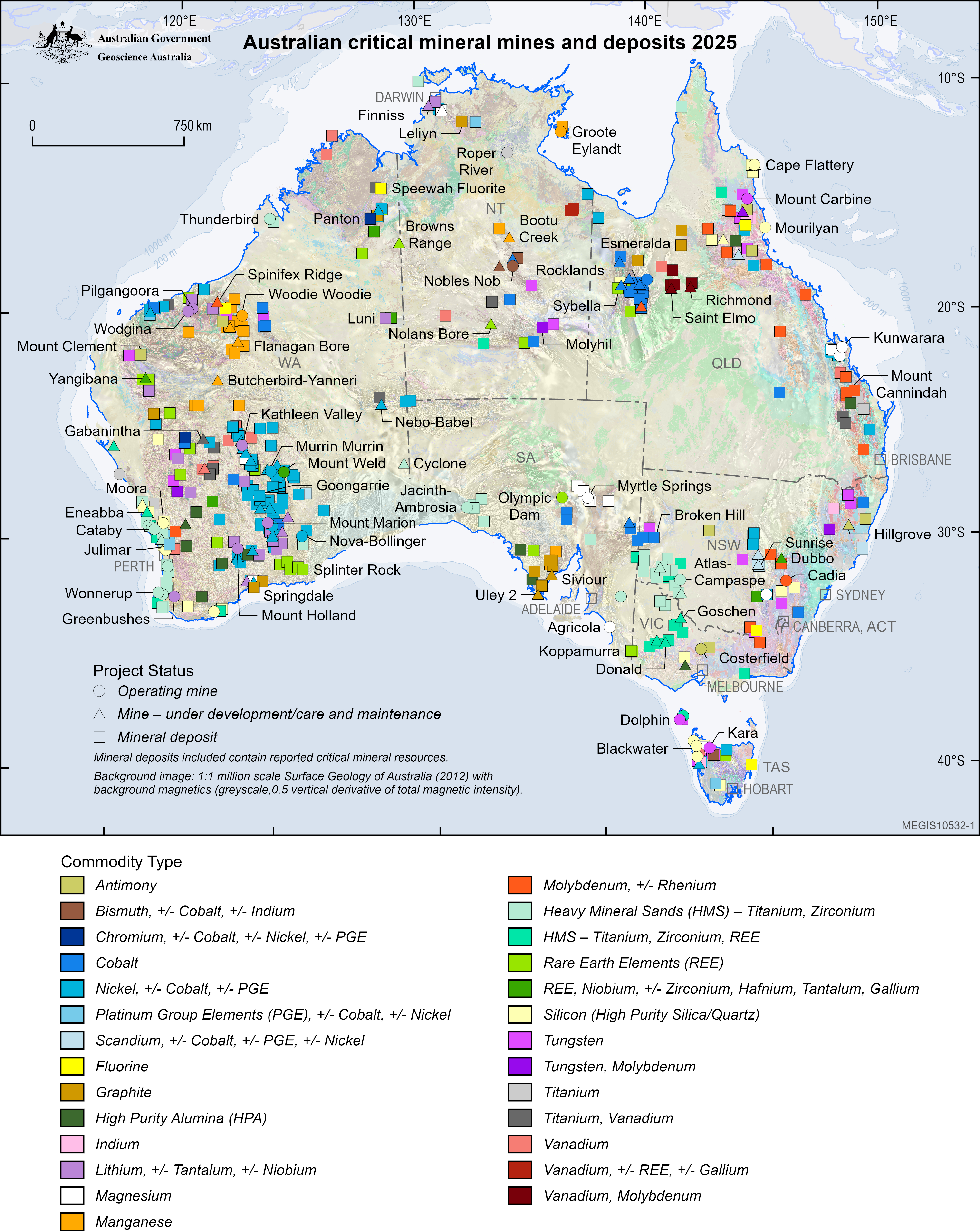
Australian critical mineral deposits and mines in 2025. Available for download along with the map data from https://doi.org/10.26186/150802.
Global critical mineral lists
Individual countries develop their own lists of critical minerals based on the relative importance of certain minerals to their industrial needs and strategic assessment of supply risks. Many of Australia’s critical minerals are also on the critical mineral lists of partner countries such as the United States, European Union, India, Japan, South Korea, Canada and the United Kingdom.
See how Australia’s critical minerals align with critical mineral lists of seven strategic partner nations.1
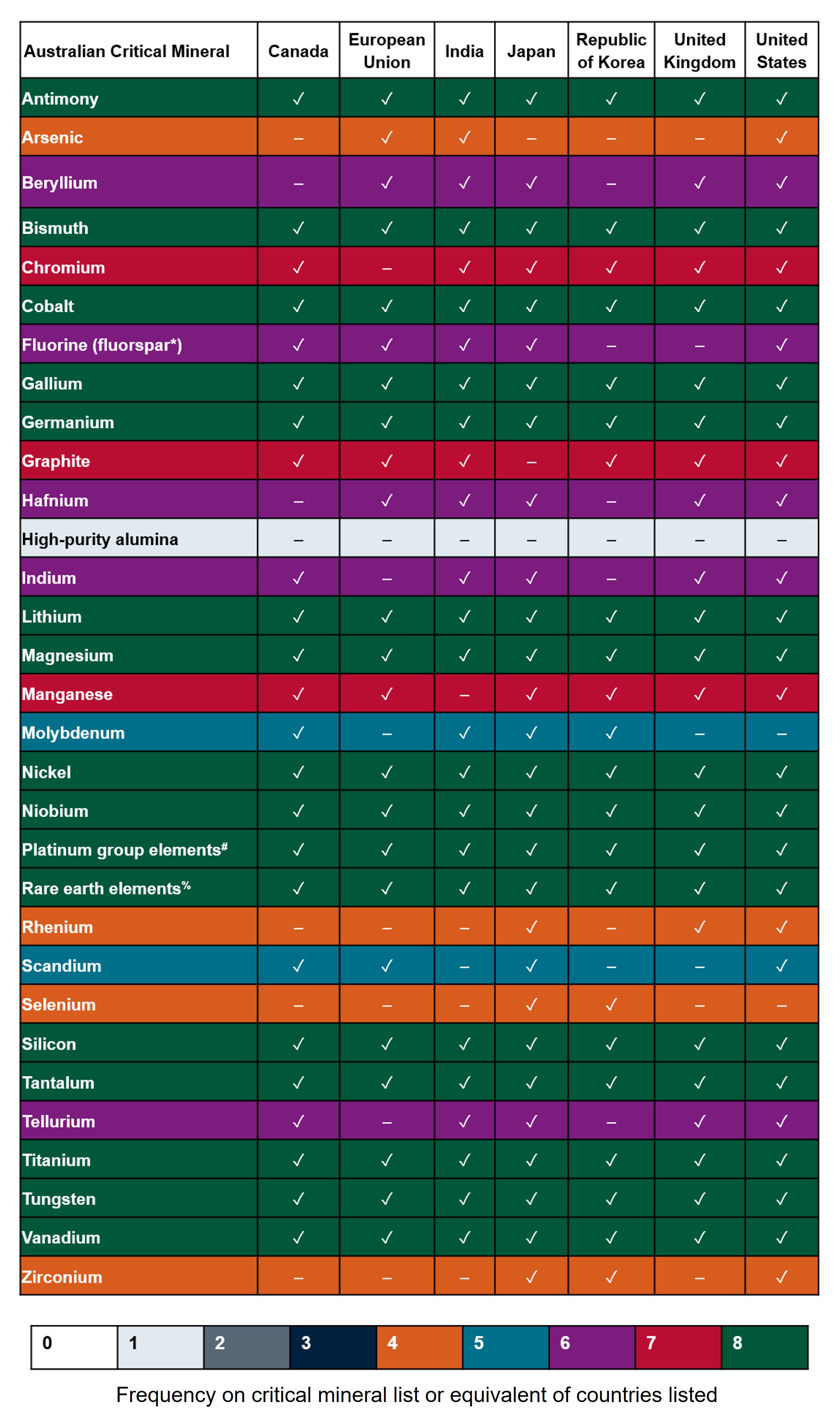
1 compiled based on critical minerals lists published by each country
- US Geological Survey releases 2025 list of critical minerals, United States Geological Survey (USGS), US Department of the Interior, Federal Government of the United States, 2025, accessed 1 October 2026.
- Fifth list 2023 of critical raw materials for the EU, European Commission, 2023, accessed 1 October 2026.
- Critical minerals for India, Ministry of Mines, Government of India, 2023, accessed 1 October 2026.
- Business Tool List. An Introduction of Support Tools for the Metals Department, Japan Oil, Gas and Metals National Corporation (JOGMEC), ), 2020, accessed 7 October 2026.
- Critical minerals list in Korea, International Energy Agency (IEA), 2023, accessed 1 October 2026.
- Canada’s critical minerals, Government of Canada, 2024, accessed 1 October 2026.
- Vision 2035: Critical Minerals Strategy, United Kingdom Department for Business & Trade, 2025, accessed 1 October 2026.
* Some countries list fluorspar instead of fluorine, fluorspar is the commercial name for the mined fluorine mineral.
# Platinum-group elements (PGE) comprise platinum, palladium, rhodium, ruthenium, iridium and osmium.
% Rare earth elements comprise the 15 lanthanide elements plus yttrium, which shares similar chemical properties. The lanthanides are lanthanum, cerium, praseodymium, neodymium, promethium, samarium, europium, gadolinium, terbium, dysprosium, holmium, erbium, thulium, ytterbium, and lutetium.