Geoscience Australia projects

Geoscience Australia and Natural Hazards

Geoscience Australia and its predecessors, the Bureau of Mineral Resources and the Australian Geological Survey Organisation, have been involved in geophysical monitoring and earthquake hazard assessment for more than 65 years.

The development of Geoscience Australia's Geohazards Program in 1995 was shaped to a significant extent by the International Decade for Natural Disaster Reduction. The Program has shown extraordinary growth since then to embrace a remarkably comprehensive range of scientific activities. They include:

  • Monitoring of natural hazards in the Australia region, particularly earthquakes, landslides, tsunami, volcanic events, sea level rise and geomagnetic storms;
  • researching the nature, origin, and occurrence of the hazards, especially floods, earthquakes, tsunami, severe winds and landslides;
  • modelling the vulnerability of buildings and infrastructure;
  • integrating socio-economic models of community vulnerability;
  • developing risk models and delivering multi-hazard risk assessments to communities and emergency managers;
  • developing information management systems to improve access to, and usage of information; and
  • educating, training and awareness raising.

The program excels in providing a comprehensive scientific knowledge base on which emergency managers can base decisions about preparedness and mitigation. It also has increased the understanding and awareness of natural hazards among communities and managers in terms of alert systems, the likely occurrence and impacts of natural disasters and improvements to information management and access capability.

The program has the potential to extend its work on risk and impact analysis by including slow onset hazards such as urban salinity, water quality and urban coastal impacts.


[back to top]

Risk and Impact Analysis Group

Formally known as the Risk Research Group, the Risk and Impact Analysis Group is part of the Geospatial and Earth Monitoring Division at Geoscience Australia.

The group develops risk models and innovative approaches to assess the potential losses to Australian communities from a range of sudden impact natural hazards. Hazard events include earthquakes, landslides, floods, tsunami, severe winds, tropical cyclones, severe storms and bushfires.

The models are being developed to assist planners and decision makers to assess community risk and the effectiveness of various mitigation strategies. The Risk and Impact Analysis Group conducts basic research into the origin and consequences of some natural hazards such as earthquakes and landslides for its hazard and risk model development. For other hazards it relies in part on basic data and hazard parameters from other agencies such as the Bureau of Meteorology.

The group is a multi-disciplinary team with a breadth of technical expertise in the geosciences, civil engineering, mathematics, socio-economics, computer programming, geographic information systems and database engineering. It also works very closely with other groups in the Geospatial and Earth Monitoring Division, particularly the Earth Monitoring Group and the National Mapping Group as well as with other Geoscience Australia divisions.

Two key drivers for activities undertaken by the Risk and Impact Analysis Group are:

  • Endorsement of the Council of Australian Governments review of natural disaster management arrangements. Read More>>; and
  • the national research priority titled Safeguarding Australia, with specific emphasis on the provision of spatial information and development of risk assessment methods.

The current project teams which support the Risk and Impact Analysis Group include the Georisk Project, the Engineering and Vulnerability Project and the Critical Infrastructure Project. Each of these has a project leader who is primarily responsible for strategic leadership and delivery of technical outputs. Projects are made up of a team of Geoscience Australia staff who undertake a range of activities which meet the objectives of the Risk and Impact Analysis Group.


[back to top]

The focus of the Risk and Impact Analysis Group

The group is working towards developing fully integrated multi-hazard risk and impact analysis tools which incorporate risk methodologies and visualisation to support the longer term Disaster Mitigation Australia Package requirements of the State and Territory Governments and local government.

The group is developing models and methods aimed at estimating the return periods for natural hazard events and the likely impacts from rapid onset natural hazards, including earthquakes, tsunami, severe winds and tropical cyclones. The group is developing a range of tools which will estimate the impact of natural hazards and provide information to emergency managers on the scale of an event's impact. The tools also will help to identify priority response areas.

Some activities include:

  • Developing an integrated earthquake risk model;
  • developing software supporting spatial representations of fluid dynamic or hydrodynamic inundation modelling, particularly for tsunami impact for various locations. Read more;
  • advancing techniques for quantifying hazard and risk across a range of natural sudden impact hazards;
  • applying direct and indirect economic modelling techniques to define the impact of natural disasters at regional and national scales;
  • developing models and methods to estimate the social vulnerability of a range of sudden impact natural hazards, Read more;
  • measuring how vulnerable people are to natural hazards, Read more;
  • landslide database interoperability, Read more;
  • national exposure information system, Read more;
  • severe wind risk modelling, Read more; and
  • fieldwork.

Georisk Project

Designed to define the national risk from a range of hazards, the Georisk Project will consider earthquakes, tsunami, strong-winds, landslides and floods. It will provide risk assessment models as well as methods and tools to support funding and mitigation decisions in direct support of the Disaster Mitigation Australia Package. It also will support a range of risk mitigation options, including emergency response, recovery and preparedness along with development of building regulations, land-use planning and insurance.

More about earthquake research

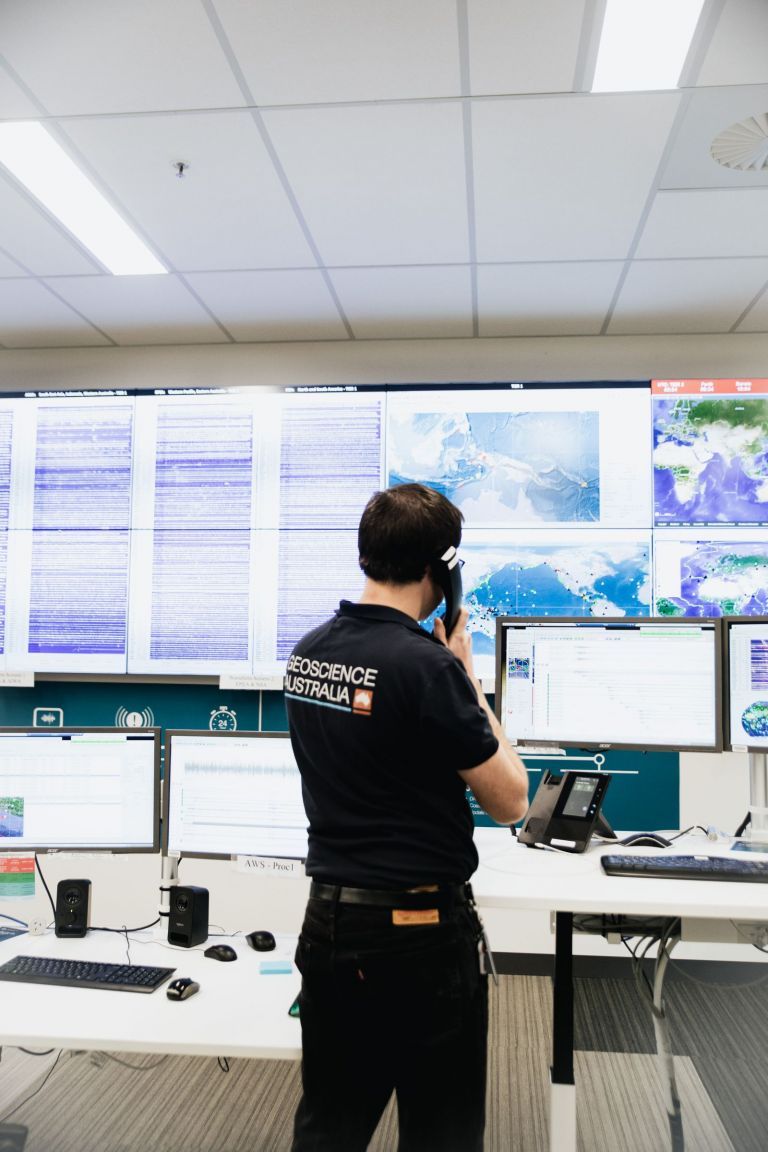
Geoscience Australia is responsible for a comprehensive program of earthquake monitoring, hazard research and risk modelling. It provides information on earthquake hazards to clients such as government agencies, industry, the media and the public and operates a 24-hour earthquake alert system for emergency managers. The earthquake hazard research encompasses source studies and ground motion studies as well as investigations of prehistoric earthquakes (palaeoseismology) and the recent tectonics of Australia (neotectonics). The research is aimed at developing better methods for estimating the hazard posed by earthquakes so that mitigation and disaster management strategies can be put in place.

Current estimates of earthquake hazard in Australia are based on the premise that historical seismic activity indicates where future activity is likely to occur and that the magnitude distribution within the region is known and will not change with time. Both these assumptions depend on having a good statistical sampling of seismic activity and confidence in the understanding of its fundamental causes.

Unfortunately, the historical record in Australia is very short, extending only about 150 years for large earthquakes. For smaller earthquakes detected and located by the seismograph network the historical record in some areas is complete only since the 1960s or later. For large, potentially damaging earthquakes, with long return periods, this time frame is far too short for a reliable estimate of hazard based only on historical seismic activity.

Adding to this, there is no definitive model for seismicity such as that available for the interplate areas of New Zealand, Japan and the western United States where the mechanism are well known. In contrast, Australia is situated within an intraplate region where the seismic activity is not associated with any major dynamic plate boundary. Although it is known that earthquakes are caused by the prevailing stress field, little is understood about how that stress interacts with the geological structure to produce the pattern seen today. The inherent problem when trying to estimate the hazard was highlighted by the Tennant Creek earthquakes in 1988 when three large events measuring more than magnitude 6.0 on the Richter scale occurred in a region thought to be practically aseismic because of its low seismic activity. Now the region is recognised on the hazard map as high-hazard along with other areas where there have been isolated large earthquakes. Significant changes to the hazard map after large events helps to illustrate how unreliable earthquake hazard information can be when it is based on inadequate available sampling of historical seismic activity.

The earthquake research at Geoscience Australia aims to address both these shortfalls by better estimating the recurrence rate and spatial location of large damaging earthquakes. This is being achieved through the capture of palaeoseismic data which is acquired by identifying and dating fault scarps formed during large pre-historic earthquakes and by undertaking research into the underlying cause of the seismic activity. The cause can be established by studying earthquake source properties and the recent stress and strain field along with the crustal structure and other attributes. The research also aims to derive better attenuation relations for Australia which are used to estimate how much ground shaking will occur as the result of an earthquake given the magnitude of the event and the distance from its epicentre. Many hazard studies currently use attenuation relations derived for eastern and western North America, which may be inappropriate for Australian earthquakes.


[back to top]

Engineering and Vulnerability Project

An understanding of what is exposed to extreme hazard events and their vulnerability is essential to an assessment of community risk. The Engineering and Vulnerability Project is directed at developing vulnerability models for the broad range of buildings and critical infrastructure in Australia, along with the progressive refinement of existing casualty models. In turn, these developing models are being used in scenario modelling and probability risk studies for the Georisk Project and the Critical Infrastructure Project. Included in the Engineering and Vulnerability Project is the development of infrastructure and demographic informationto underpin impact assessments by defining the nature of assets and national populations.

Critical infrastructure impact assessments need to link the vulnerability of the entire utility system to the operational loss of key components because damage to utility components can compromise spatially distributed and interdependent assets. This in turn can lead to operational failures which have an impact on communities. The Engineering and Vulnerability Project is contributing to the understanding of behavioural vulnerability and risk by helping to validate utility models under development in the Critical Infrastructure Project. In addition, for both buildings and critical infrastructure, the project is developing tools to identify engineering factors influencing vulnerability and to evaluate cost effective mitigation strategies for owners, regulators and government.

The project has clients within Geoscience Australia and externally. The key internal clients are the Critical Infrastructure Project and Georisk Project which make direct use of the vulnerability models and exposure information. External clients and stakeholders include Standards Australia, the Australian Building Codes Board, the insurance industry, universities and State government departments responsible for providing guidelines for infrastructure development.


[back to top]

Unless otherwise noted, all Geoscience Australia material on this website is licensed under the Creative Commons Attribution 2.5 Australia Licence.