Earth science and the next generation of Earth scientists will shape our future!
Page last updated:8 October 2025
We are all responsible for caring for our planet and understanding how its systems work in harmony: it provides us with the air we breathe, the water we drink, and the food we eat!
Did you know Earth science will be one of 8 sciences that will be most in demand in Australia over the next decade to address some of the nation’s biggest challenges?
Every day we benefit from Earth science, from switching on the light to turning on the tap. Earth science gives us the knowledge and tools to address current and future global challenges like climate change, resource management, and disaster preparedness. It helps us understand our planet's systems, predict future changes, and develop solutions for a more sustainable world.
Did you know Australia has a vibrant Earth science community, with researchers, educators, and professionals in the public and private sectors, all working across various disciplines like geology, geospatial, oceanography, and environmental science to safeguard our future?
Organisations like Geoscience Australia, the Geological Society of Australia and the Australian Academy of Science foster collaboration, share scientific outcomes and the impact of Earth science, as well as advocate for this important field of work. These organisations believe in a better future and they provide information and data to educate and inform sound decision-making by industry, government and the community.
Earth science as a career
Earth science is a career path that is full of possibilities. It is diverse, accessible, and well-paid, with opportunities to flex your creativity, fuel your curiosity, work in collaborative teams, and grow as a leader. From the red heart of Australia to our vast oceans, the frozen frontiers of Antarctica, and even outer space, Earth science careers span every corner of our planet – and beyond.
Did you know that a career in Earth science can happen anywhere? In the great outdoors you could be:
- an oceanographer researching the Southern Ocean surrounding Antarctica
- a geologist identifying rocks and minerals out in the field!
If you want to work indoors, you could be:
- an Earth observation expert, working with powerful computers to analyse spectral data from satellites
- working in a lab making new discoveries from samples
- a geospatial expert building the location framework that tells us where we are!
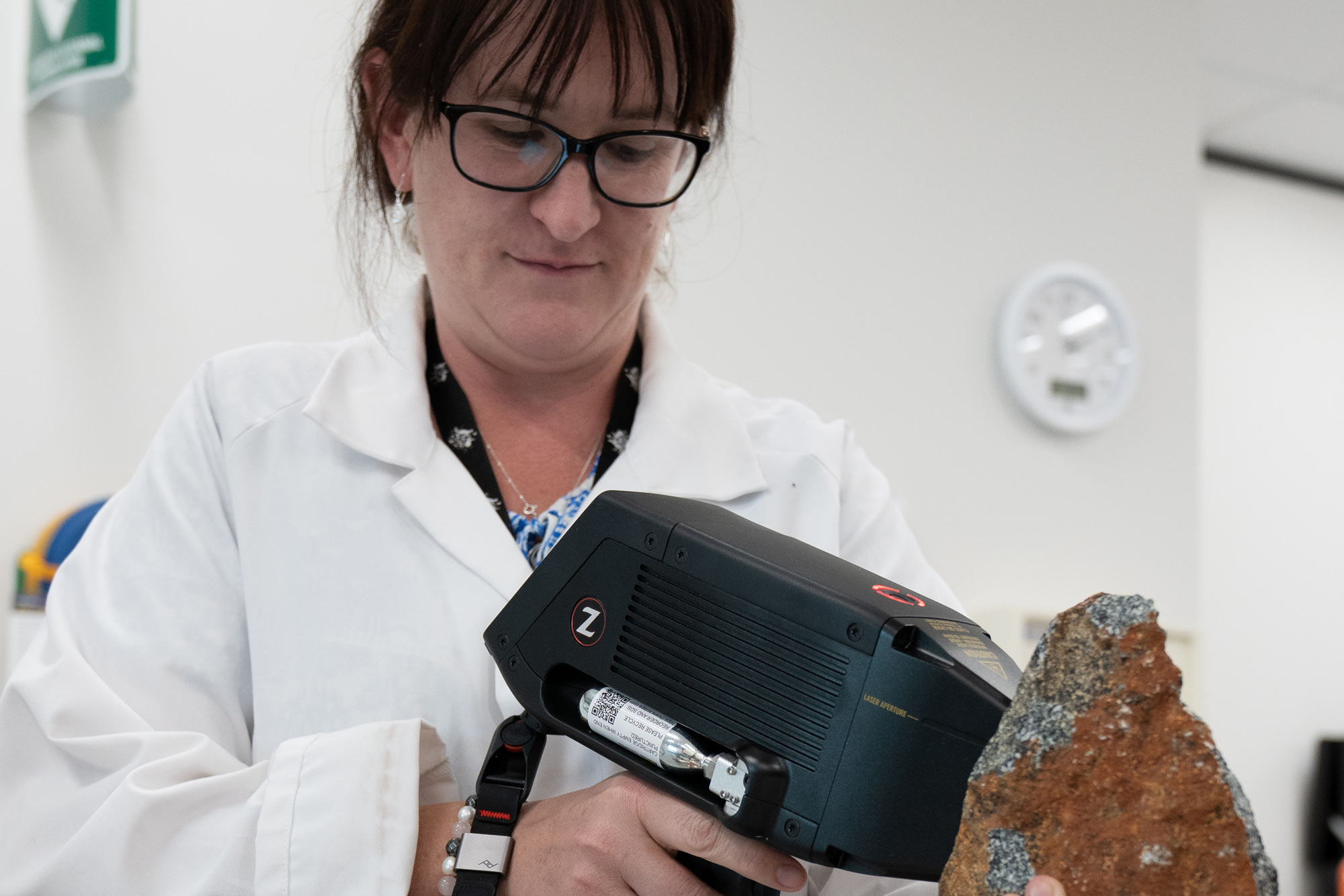
Studying samples in the lab (Image: Geoscience Australia)
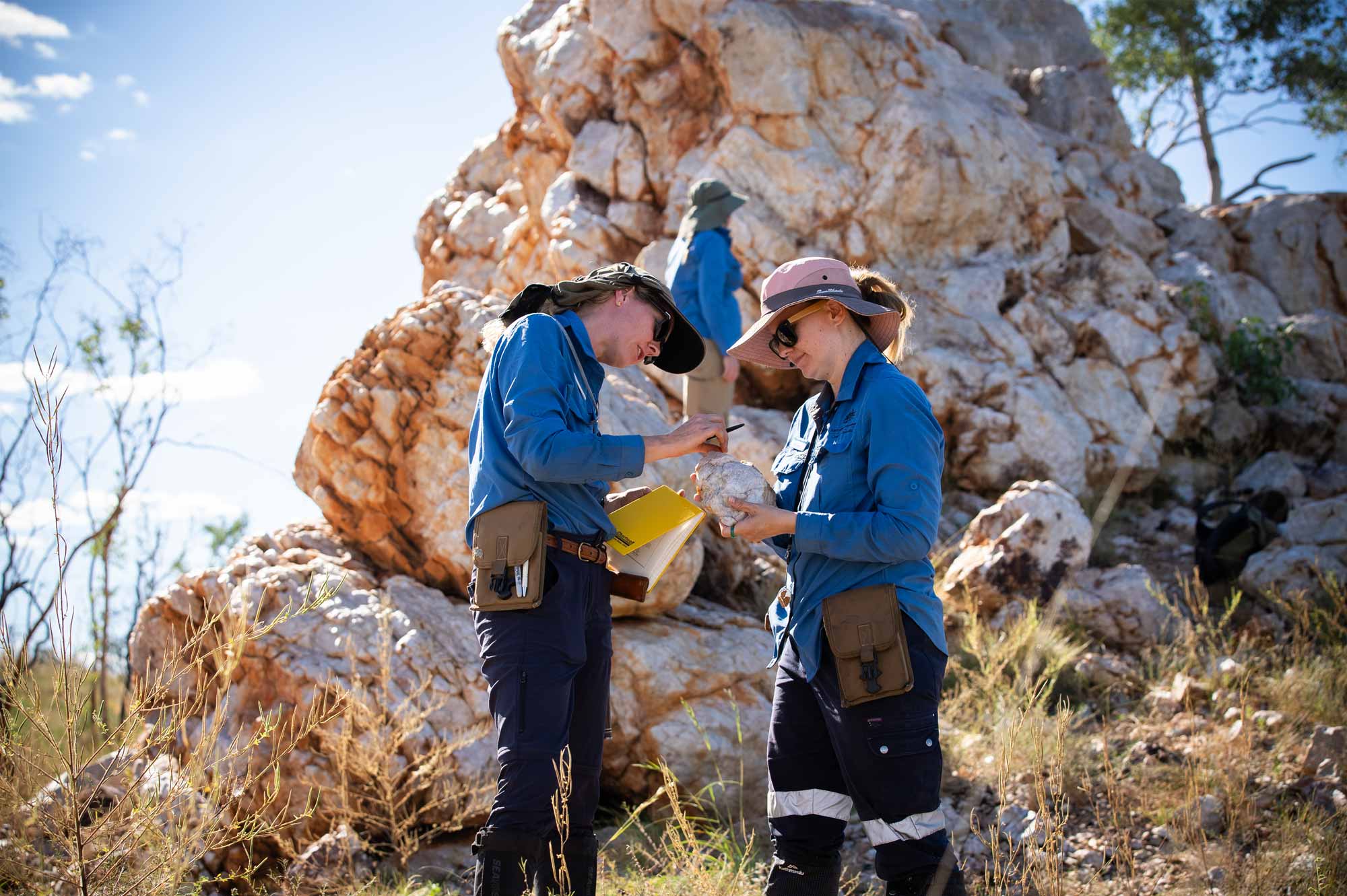
Examining rock samples in the field (Image: Geoscience Australia)
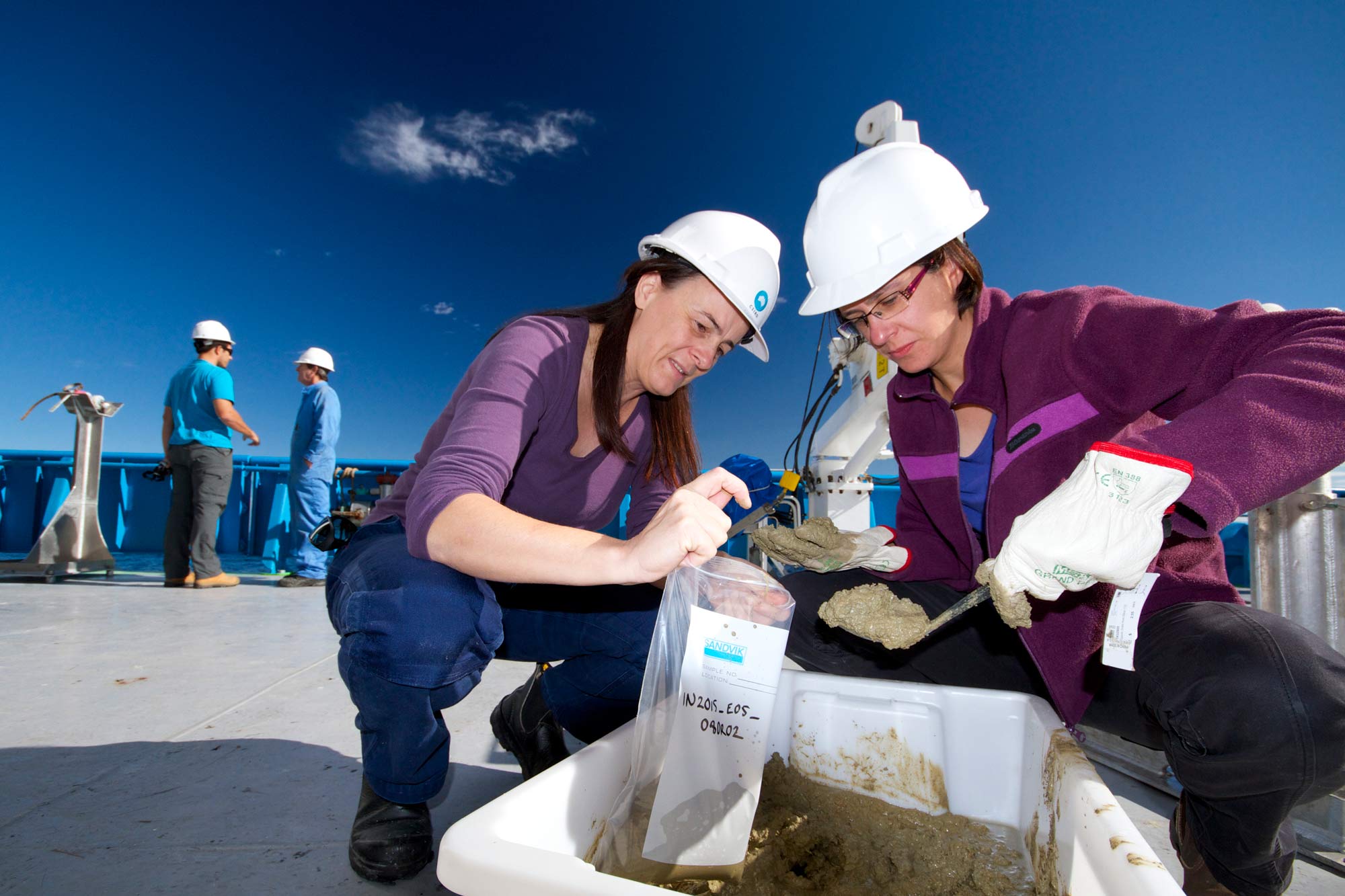
Taking samples at sea. (Image: CSIRO Marine National Facility)
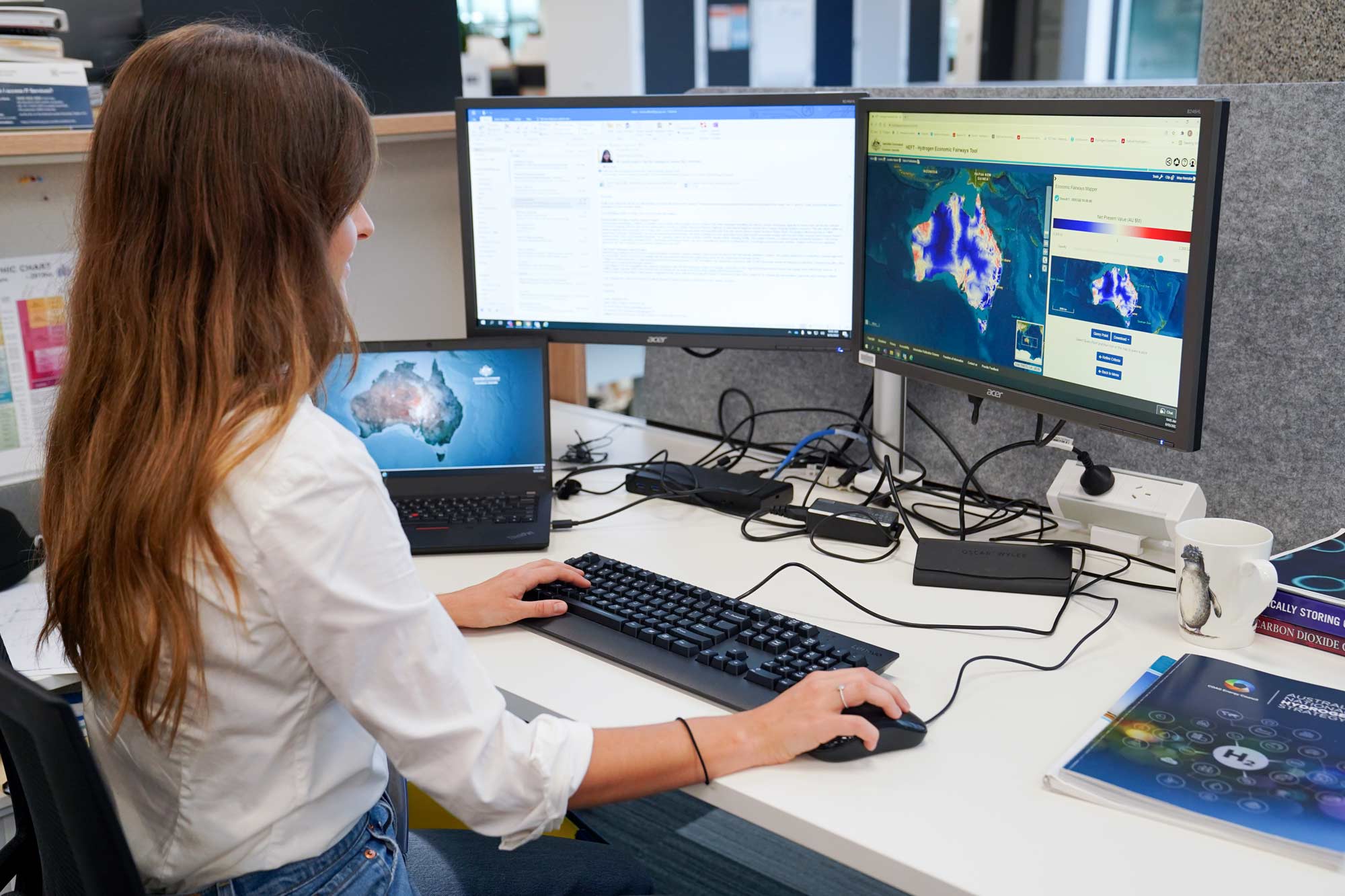
Examining data to make new discoveries (Image: Geoscience Australia)
A career in Earth science is future-proof, and we need more curious minds to consider becoming our next generation of Earth scientists. Whether you're drawn to solving global challenges, exploring natural phenomena, or protecting our planet, there's a place for you in Earth science. If you like storytelling, then maybe a career as a science educator or communicator is for you. These people have a vital role in making science understandable, increasing the public’s science literacy and inspiring the next generation of thinkers and doers. If you’re passionate about the planet, Earth science is your calling.
There are many pathways for a career in Earth science, including university education and graduate programs, like Geoscience Australia's Graduate Program. If university isn’t your style, you can get into Earth science with TAFE courses in subjects like environmental management or geographic information systems. The variety of options is huge!
Download our career flyer for more information on what a career in geoscience can look like!
Explore Earth science today!
Ready to become an Earth science explorer? You don’t need a lab coat or a passport - just a curious mind and maybe a pair of comfy shoes! Australia is bursting with places to discover Earth science in action, and some of the best ones might be right in your own backyard.
Start small:
- Watch the clouds roll by and learn to read the weather like a pro.
- Stargaze and spot constellations (bonus points if you find the Southern Cross!).
- Dig into your garden - what’s the soil like? Sandy and loose or firm and clay-like? It tells a story about drainage, plant life, and even local geology.
- Build a compost bin and turn food scraps into garden gold.
- Become a bug detective or plant whisperer - what species can you spot?
Feeling adventurous?
- Head to your local science museum for hands-on fun.
- Take a bushwalk and keep your eyes peeled for cool rocks, fossils, and landforms.
- Try identifying different types of trees, birds, or even fungi - nature’s full of surprises!
Whether you're in the suburbs or the outback, Earth science is everywhere. Grab your explorer’s hat and start investigating the world around you!
Come and visit us!
If you’re in Canberra and want to come and say hello, our indoor public spaces at our Symonston headquarters are open business hours, Monday to Friday. We love to welcome visitors to discover Earth science and our work. Start planning your visit today!
Our public space has a wonderful display featuring just some of the items from our National Mineral and Fossil Collection, as well as our ‘Rocks That Shape Australia’ exhibit—and the only moon rock in the Southern Hemisphere that you’re allowed to touch!
If you can’t get to the nation’s capital then don’t worry, you can see our Education Centre in a virtual tour! Take a look at our space and some of the exhibits and resources that could fascinate and inspire you today! Start the tour.
If you are visiting us and want to stretch your legs, take a stroll through time. Our Geological TimeWalk, which leads you on a 1.1 kilometre journey through the Earth's 4600 million year history. Each rock has a story to tell, with geological, economic, environmental and/or cultural significance. If you are not in Canberra or would like a preview before you visit, click below to take a virtual tour back in time!
Join our Chief Scientist Dr Steve Hill as he shows us some of the rocks that make up the Geological TimeWalk. (Source: Geoscience Australia YouTube)
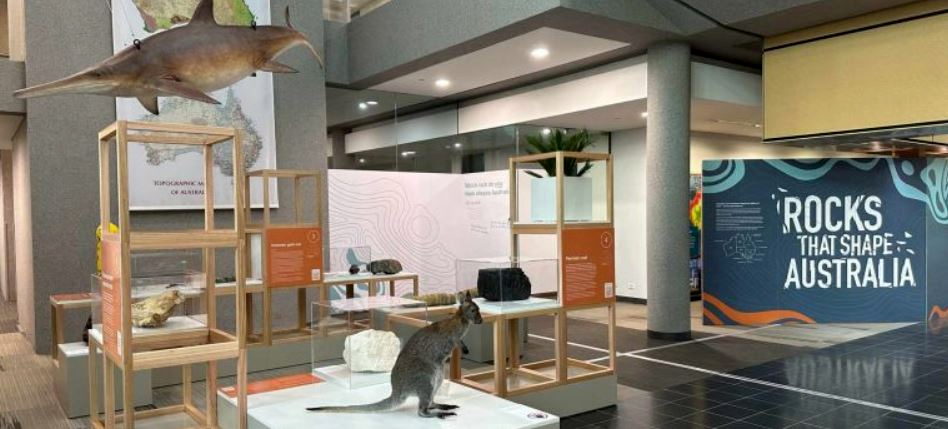
The Rocks That Shape Australia exhibition in the foyer of the Geoscience Australia Symonston Building in Canberra. (Image: Geoscience Australia)
Get to know a science communicator!
Our Education Centre lets students discover the Earth sciences through curriculum-linked, hands-on activities that keep them captivated, focused and looking for more, with the support of our specialist team. Tamara Alden, from the Education and Outreach team, takes us through the career pathway that she took and how she works every day to inspire and encourage budding Earth scientists.
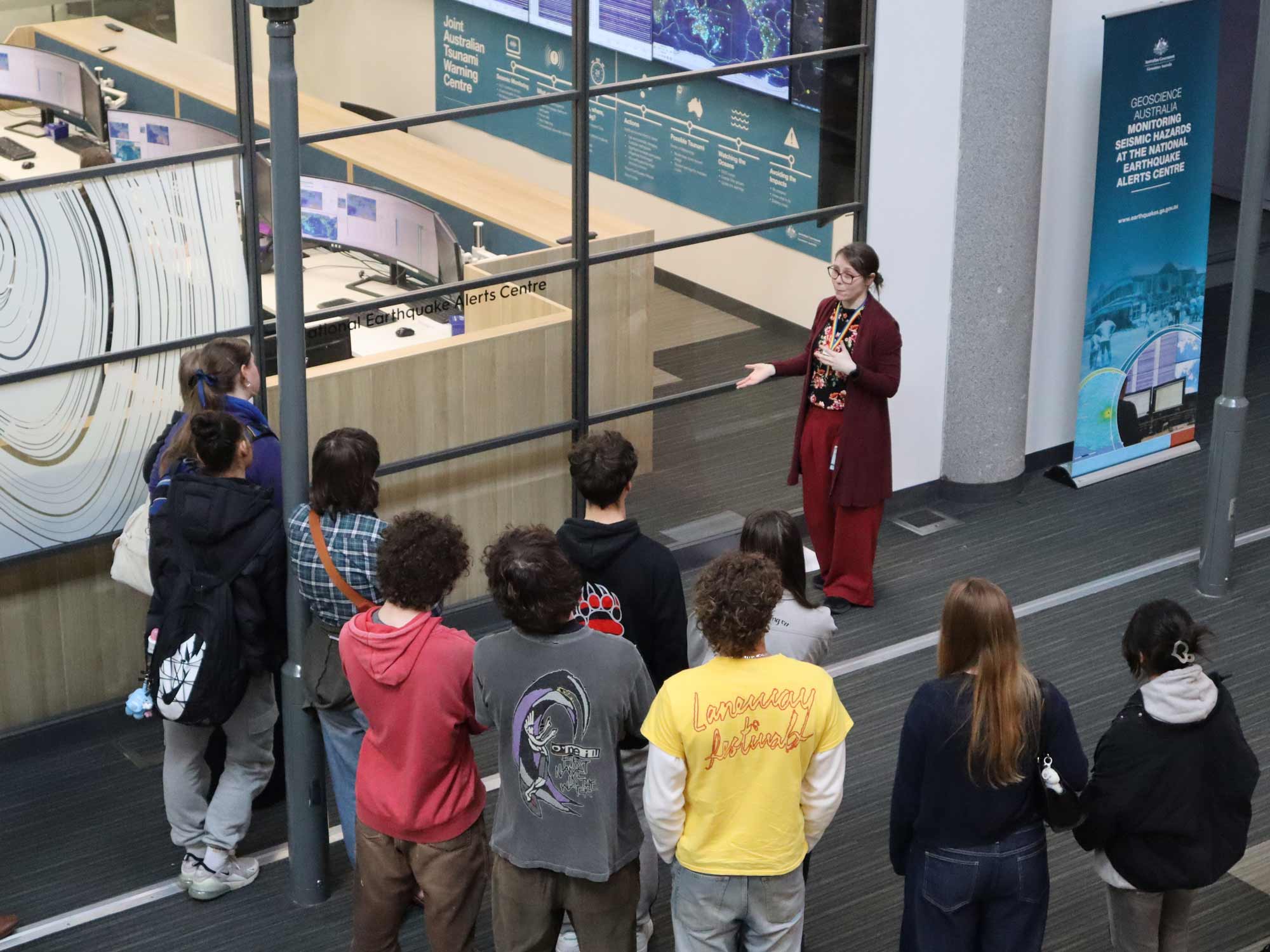
Tamara Alden explaining how the scientists in the National Earthquake Alerts Centre, which operates 24/7 from Geoscience Australia’s headquarters, provides near real time data to other parts of government when an earthquake occurs (Image: Geoscience Australia)
What does a day in the life of a science communicator look like?
Every day is always different! In a lot of ways, I do many things similar to when I was a teacher but for a much wider audience then just my own classroom. Often, I am presenting in front of a group of students, either physically or virtually. Each visit covers different geoscience topics, so I might be describing properties of rocks and minerals, and which everyday objects are made from these Earthly materials, or I might be explaining how earthquakes form and how do we monitor for them in Australia.
Having been a teacher before being a science communicator, I understand the impact educators can have in building a lasting understanding and being an inspiration for students. The challenge is that many teachers don’t have a background in geoscience and find it difficult to teach. So, a big part of my role is empowering educators, by building geoscience knowledge through professional development sessions and by creating curriculum-aligned geoscience themed educational resources. These cover a range of geoscience and geography topics that can be accessed and used freely by all educators across Australia.
What is the best part of your job?
The students. Being a part of the students’ passion or curiosity about geoscience and being able to build upon that and share my excitement with them. I love hearing stories from students about their own rock collections back home or sharing times they have visited different places across Australia and saw an interesting rock formation or how they got a cool mineral or gemstone.
The part of my job I love most is the questions I get asked by students. This is what makes each visit and virtual experience unique and with each new question I get to test and build my skills and knowledge. More importantly, it’s where I get to observe those scientific skills of curiosity and questioning being practised in real time and see the potential of those students to be future scientists.
What inspired you to become a science communicator?
I loved learning science as a student at school as I was always curious about how the world works. I wanted to know why pyrite (fool’s gold) forms in cubic shapes, why Himalayan pink salt is pink, why earthquakes occur in some places more often than others? I was a hard-working student and despite my passion for science and maths, they didn’t come easily to me. This drove me to want to help others who were struggling to understand too. So, as I learnt new things in class I would help teach them to my friends and fellow students.
I didn’t know jobs as science communicators existed until I was an adult teaching in my first school. Transitioning from being a teacher to a science communicator allowed me to hold onto the aspects of teaching I enjoyed most while allowing me more time to pursue scientific knowledge.
What did your pathway to this career look like?
I went to Monash University in Victoria and completed a Bachelor of Science with the intention of doing a Master of Education afterwards to become a science teacher. I focused on maths and chemistry and chose Earth science as a fun elective science topic. Little did I know that it would become one of my majors, and that I would go on to complete a geochemistry themed Honours research project.
After completing my university degree, I gained my Master of Teaching in partnership with the Australian Catholic University while simultaneously working fulltime as a secondary teacher in a regional school in Shepparton, Victoria. This meant I could take what I was studying in my degree and put it into practise in my classroom. At completion of the Masters, I moved to teach in a secondary school in southeastern suburbs of Victoria for another year.
I then moved to Canberra as my husband got a job opportunity up there, and I intended to continue being a teacher. I was told by a friend working as a satellite data scientist for Geoscience Australia that an opening had come up in the Education and Outreach team as a science communicator and they encouraged me to apply. The role was the perfect combination of geoscience and education that I had been looking for and I have been happily working here for the past 3.5 years.
What impact does science communication have on our lives?
My job is not just teaching the scientific concepts themselves, it's also highlighting how science is relevant to our lives and the importance it has. This not only makes the concepts stick better for the students but also inspires them to be more curious about where their everyday objects come from and how many of them need Earthly materials to make them. It’s also important that everyone, not just scientists, have a basic understanding of scientific concepts, can understand how to interpret datasets and think critically. These skills and knowledge empower people to make informed decisions like where is the best location to build my home to avoid flood plains or coastal erosion, or what type of soil do I need to encourage the best yields in the vegetable patch.
What is your favourite example of your work in action?
It’s the moments when I can see that I have been a part of inspiring a student to want to know more about geoscience. Like when a student has been super curious and asking lots of questions and demonstrates they already have some passion or knowledge of geoscience by the end of the visit says that they want to come work here one day. Or even the opposite where a student who initially seemed a bit disengaged and sees something in the Education Centre display and asks about it and shows interest despite their lack of interest normally in geoscience. Or being able to help a student with a misconception about something and seeing the light bulb moment of understanding.
For National Science Week 2022, I created a glass themed virtual exhibit resource as the theme was ‘Glass, more than meets the eye’. This project was particularly challenging as it was one of my first major projects since joining the Education and Outreach team, I had little to no knowledge of natural and manmade glass, and I had never used the Google, Arts and Culture platform before to make a virtual exhibit.
Making this resource a virtual exhibit, it meant that anyone could access the knowledge in a clear and simple way and making the natural glass samples available to more people then could ever see them physically in our education centre. This project allowed me to develop my knowledge and skills, while collaborating with a wide range of scientists and experts to ensure that I was creating a resource that was accurate, accessible and interesting to use.
What is your favourite Earth science-themed song?
Coastlines by Hollow Coves. I grew up in Perth and always going to the beach and it's now become my travel song. Whenever I have moved to a new place, I play that song.
Thank you to Tamara for sharing her story with us!
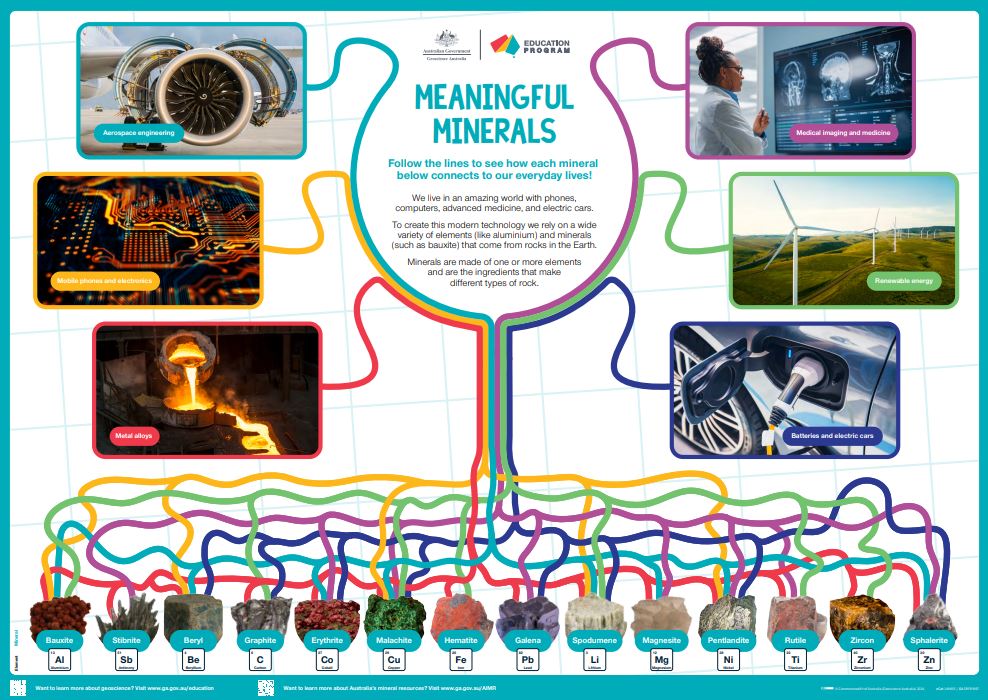
For the kids! Download our ‘Meaningful Minerals’ poster
We live in an amazing world with phones, computers, advanced medicine, and electric cars. Check out our Meaningful Minerals poster to explore how different minerals connect to our everyday lives!
Learn about the Pilkington Jackson Globe which you can visit at Geoscience Australia!
The Philips (Pilkington Jackson) globe is a historically and scientifically significant item for the Australian geological community. It is an amazing portrayal of how science and our knowledge of the Earth evolves. (Source: Geoscience Australia YouTube)