Australia's Energy Commodity Resources 2025 Coal
Page last updated:23 October 2025
Coal
Black Coal
|
TDR 1,959,440 PJ ( 0.8%) | |
|
EDR 1,855,256 PJ ( 0.9%) |
|
Production 10,784 PJ ( 3.9%) | |
|
Exports 9,606 PJ ( 5.6%) $103.2 b ( 9.3%) |
|
Production World Ranking 5 (6%) | |
|
Export World Ranking 2* (25%) |
Brown Coal
|
TDR 3,247,899 PJ (-) | |
|
EDR 730,660 PJ (-) |
|
Production 401 PJ ( 3.6%) | |
|
Exports nil |
|
Production World Ranking 9 (3%) | |
|
Export World Ranking - (-) |
Notes
Statistics are for 2023 except production and export income that are reported on a financial year basis (2022–23). Percentage increases or decreases are in relation to 2022. World rankings are followed by percentage share in brackets *Australia ranks second behind Indonesia for total (black and brown) coal exports with 25% (>9000 PJ) of world coal exports (Energy Institute, 2024). TDR – Total Demonstrated Resources (the sum of Economic and Subeconomic Demonstrated Resources); EDR – Economic Demonstrated Resources; PJ – petajoules; $b – billion dollars (Australian).
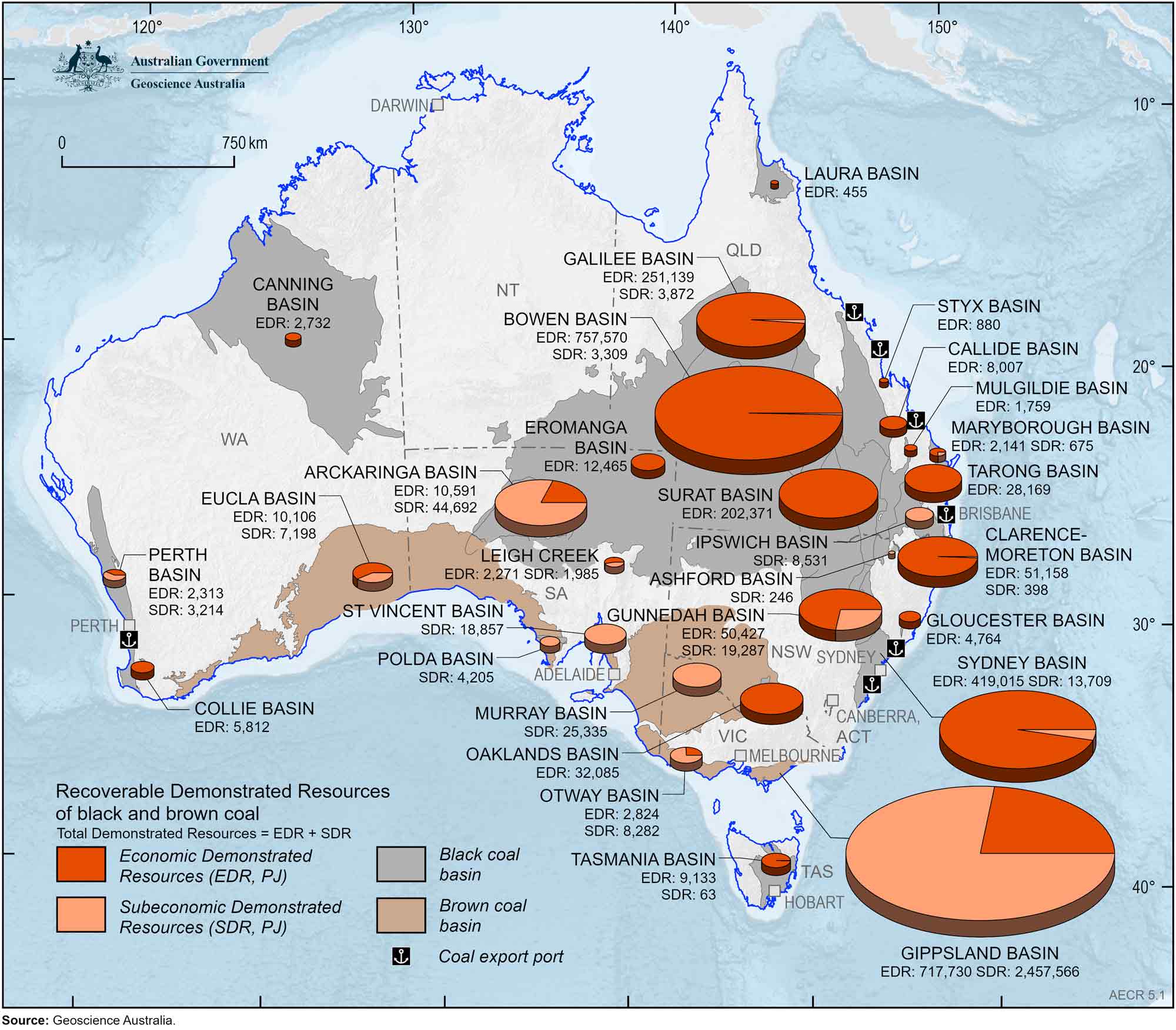
Figure 5.1 Australia’s total recoverable Demonstrated Resources of black and brown coal as at end 2023 (PJ). For physical units (Mt) refer to Table 5.1
Highlights
- Coal is Australia’s most significant energy resource. As of December 2023, Australia’s recoverable Total Demonstrated Resources of black coal were estimated at 1,959,440 PJ (77,750 Mt). Recoverable Total Demonstrated Resource of brown coal were estimated at 3,247,899 PJ (331,424 Mt).
- Australia ranks fourth, globally, for black coal Economic Demonstrated Resources and second for brown coal Economic Demonstrated Resources. At the end of 2023, Australia’s recoverable Economic Demonstrated Resources were 1,871,757 PJ (72,875 Mt) for black coal and 730,660 PJ (74,039 Mt) for brown coal.
- Australia is the fifth largest producer, the second largest exporter and has the third largest reserves of coal in the world (Energy Institute, 2024).
- During 2022–23, export earnings from black coal totalled $103.2 billion, down 9.3% from $113.8 billion in 2021–22 (DISR, 2024).
- In 2023, coal exploration expenditure was $322.3 million, an increase of 34% on 2022 ($241.2 million). Coal exploration was approximately 6% of the 2023 total exploration spend in Australia (ABS, 2024).
Coal resources
Australia’s coal resources are expressed as Economic Demonstrated Resources (EDR), Subeconomic Demonstrated Resources (SDR) and Inferred Resources. Refer to Appendix 3 for definitions of these terms and further information on the National Classification System for reporting of Identified Mineral Resources. At 31 December 2023, Australia had substantial EDR (Figure 5.1) and Inferred Resources (Figure 5.2) of black and brown coal (Table 5.1 and Table 5.2).
Black coal
Most of Australia’s black coal EDR are located in Queensland and New South Wales, followed by smaller volumes in South Australia, Western Australia and Tasmania. There are two main types of black coal products: metallurgical coal and thermal coal. Metallurgical coal (also called met coal or coking coal) is mostly used for steel making and other industrial processes. Thermal coal (also called steaming coal) is used for electricity generation.
Total in-situ resources of black coal in Australia (EDR plus SDR plus Inferred Resources) are estimated at 192,232 Mt, comprising 85,774 Mt of EDR, 7,104 Mt of SDR and 99,354 Mt of Inferred Resources (Hughes et al., 2025). Australia’s total recoverable Identified Resources of black coal are estimated to be 155,480 Mt (3,819,529 PJ), comprising 72,487 Mt (1,855,256 PJ) of EDR, 5,264 Mt (104,185 PJ) of SDR and 77,730 Mt (1,860,089 PJ) of Inferred Resources (Table 5.1). Australia is thought to hold 9% of world economic resources of black coal, ranking fourth behind the United States (27%), China (19%) and India (17%; Federal Institute for Geosciences and Natural Resources, 2024).
Brown coal
Total in situ resources (all categories) of brown coal, are estimated to be 488,664 Mt, of which in situ EDR are 81,234 Mt, SDR are 284,921 Mt and Inferred Resources are 122,509 Mt. Total recoverable Identified resources of brown coal are estimated at 436,651 Mt (4,283,623 PJ), of which recoverable EDR are 74,039 Mt (730,660 PJ), SDR are 257,384 Mt (2,517,239 PJ) and Inferred Resources are 105,228 Mt (1,035,724 PJ; Table 5.2). Nearly all of Australia’s recoverable brown coal EDR is in Victoria, with more than 90% in the Gippsland Basin (Latrobe Valley). Australia is estimated to hold 23% of the world’s economic resources of brown coal, ranking second in the world behind Russia (28%) (Federal Institute for Geosciences and Natural Resources, 2024).
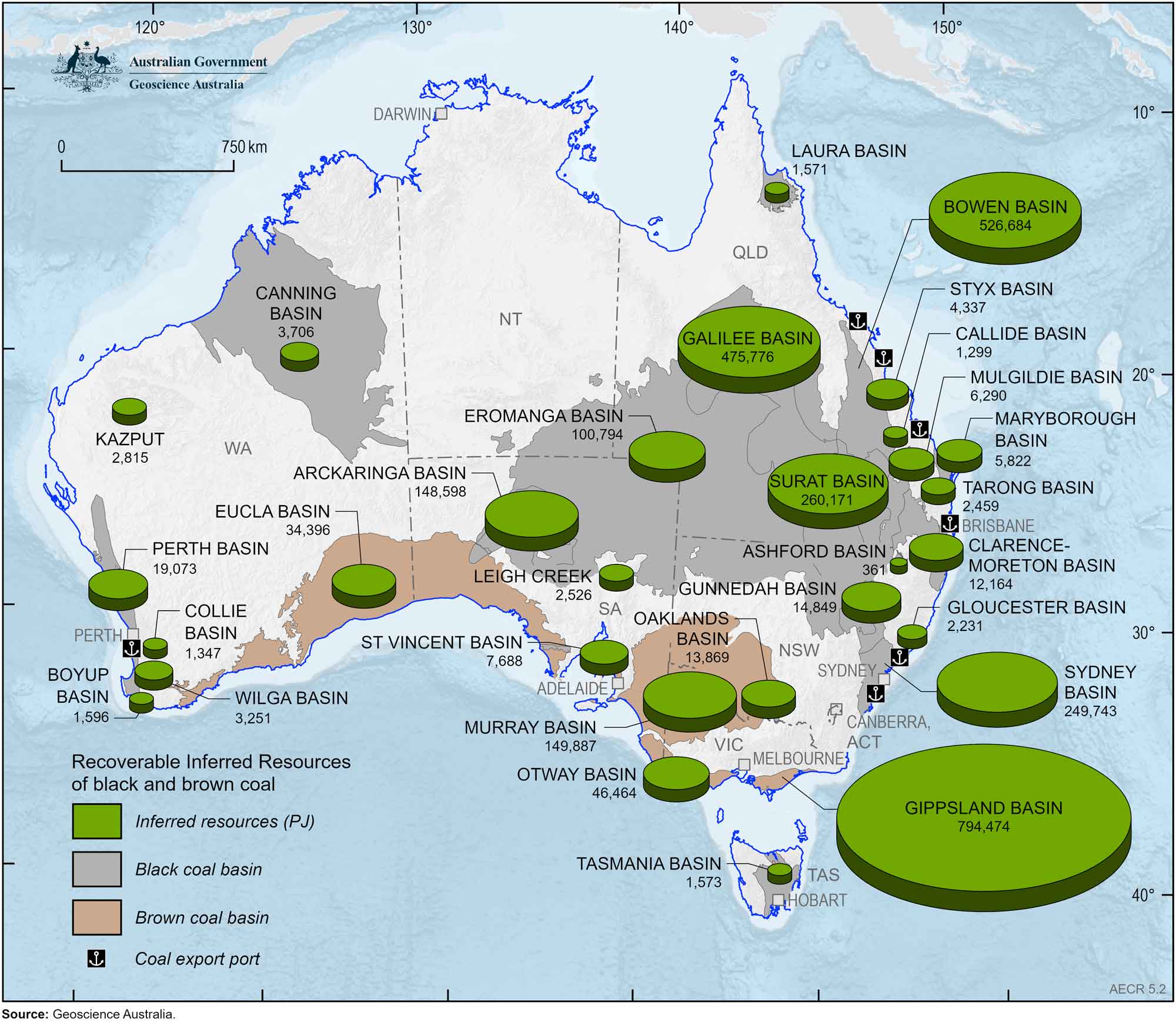
Figure 5.2 Australia’s black and brown coal Inferred Resources as at end 2023 (PJ). For physical units (Mt) refer to Table 5.1 and Table 5.2
Table 5.1 Australia's remaining black coal resources by basin area to year end 2023 (Mt and PJ).
| Basin | Black Coal | |||||
|---|---|---|---|---|---|---|
| EDR (PJ) | SDR (PJ) | Inferred (PJ) | EDR (Mt) | SDR (Mt) | Inferred (Mt) | |
| Arckaringa | 10,591 | 44,692 | 148,598 | 623 | 2,538 | 8,577 |
| Ashford | 0 | 246 | 361 | 0 | 8 | 13 |
| Bowen | 757,570 | 3,309 | 526,684 | 27,667 | 123 | 19,108 |
| Boyup | 0 | 0 | 1,596 | 0 | 0 | 81 |
| Callide | 8,007 | 0 | 1,299 | 430 | 0 | 70 |
| Canning | 2,732 | 0 | 3,706 | 139 | 0 | 188 |
| Clarence-Moreton | 51,158 | 398 | 12,164 | 1,926 | 15 | 454 |
| Collie | 5,812 | 0 | 1,347 | 295 | 0 | 68 |
| Eromanga | 12,465 | 0 | 100,794 | 594 | 0 | 4,800 |
| Galilee | 251,139 | 3,872 | 475,776 | 11,282 | 176 | 21,227 |
| Gloucester | 4,764 | 0 | 2,231 | 178 | 0 | 84 |
| Gunnedah | 50,427 | 19,287 | 14,849 | 1,868 | 945 | 550 |
| Ipswich | 0 | 8,531 | 0 | 0 | 328 | 0 |
| Laura | 455 | 0 | 1,571 | 15 | 0 | 52 |
| Leigh Creek* | 2,271 | 1,985 | 2,526 | 151 | 131 | 166 |
| Maryborough | 2,141 | 675 | 5,822 | 74 | 23 | 198 |
| Mulgildie | 1,759 | 0 | 6,290 | 65 | 0 | 233 |
| Oaklands | 32,085 | 0 | 13,869 | 1,395 | 0 | 603 |
| Pedirka | 0 | 0 | 0 | 0 | 0 | 0 |
| Perth | 2,313 | 3,214 | 19,073 | 117 | 177 | 991 |
| Polda | 0 | 4,205 | 0 | 0 | 288 | 0 |
| Styx | 880 | 0 | 4,337 | 31 | 0 | 152 |
| Surat | 202,371 | 0 | 260,171 | 8,145 | 0 | 10,209 |
| Sydney | 419,015 | 13,709 | 249,743 | 15,655 | 509 | 9,547 |
| Tarong | 28,169 | 0 | 2,459 | 1,437 | 0 | 125 |
| Tasmania | 9,133 | 63 | 1,573 | 401 | 3 | 69 |
| Wilga | 0 | 0 | 3,251 | 0 | 0 | 165 |
| Total | 1,855,256 | 104,185 | 1,860,089 | 72,487 | 5,264 | 77,730 |
|
Change from 2022 (%) | 16,501 (-0.9%) |
̵̵ (0.0%) | 9,202 (-0.5%) | 388 (-0.5%) |
̵̵̵ (0.0%) | 295 (-0.4%) |
Table 5.2 Australia's remaining brown coal resources by basin area to year end 2023 (Mt and PJ).
| Basin | Brown Coal | |||||
|---|---|---|---|---|---|---|
| EDR (PJ) | SDR (PJ) | Inferred (PJ) | EDR (Mt) | SDR (Mt) | Inferred (Mt) | |
| Eucla | 10,106 | 7,198 | 34,396 | 513 | 365 | 1,746 |
| Gippsland | 717,730 | 2,457,566 | 794,474 | 73,238 | 250,772 | 81,069 |
| Kazput* | 0 | 0 | 2,815 | 0 | 0 | 153 |
| Murray | 0 | 25,335 | 149,887 | 0 | 3,478 | 15,295 |
| Otway | 2,824 | 8,282 | 46,464 | 288 | 845 | 6,181 |
| St Vincent | 0 | 18,857 | 7,688 | 0 | 1,924 | 784 |
| Total | 730,660 | 2,517,239 | 1,035,724 | 74,039 | 257,384 | 105,228 |
| Change from 2022 (%) | ̵̵̵ (0.0%) | ̵̵̵ (0.0%) | ̵̵̵ (0.0%) | ̵̵̵ (0.0%) | ̵̵̵ (0.0%) | ̵̵̵ (0.0%) |
Abbreviations on tables 5.1 and 5.2
EDR = economic demonstrated resources. SDR = subeconomic demonstrated resources. Mt = million tonnes. PJ = petajoules.
Notes on tables 5.1 and 5.2
Additional coal resources are also present outside of these basin areas, which are included in the totals documented in AECR. The data shown have been rounded. *Kazput and Leigh Creek are deposits. Source: Geoscience Australia OZMIN database, 2025.
Production and Trade
In 2023, Australia accounted for nearly 7% of coal production (black and brown), ranking fifth behind China (52%), India (9%), Indonesia (9%) and the United States (7%) (Energy Institute, 2024). During 2023, Australia had 95 operating black coal mines, 3 operating brown coal mines (Figure 5.3), and more than 300 known coal deposits. Most of Australia’s black coal is produced in Queensland (57%) and New South Wales (42%), the remainder is mined in Western Australia and Tasmania. Brown coal produced in Victoria, mainly from the Gippsland Basin, contributed 39.0 Mt and 401 PJ equating to nearly 9% of total coal production and nearly 4% of total coal energy production in 2022-23 (DCCEEW, 2024).
In 2022–23 Australia’s production of saleable black and brown coal was 11,184 PJ, which accounted for 54% of total energy production (including uranium production; DCCEEW, 2024). In 2022–23, 89% of Australia’s black coal energy production was exported (Figure 5.4).
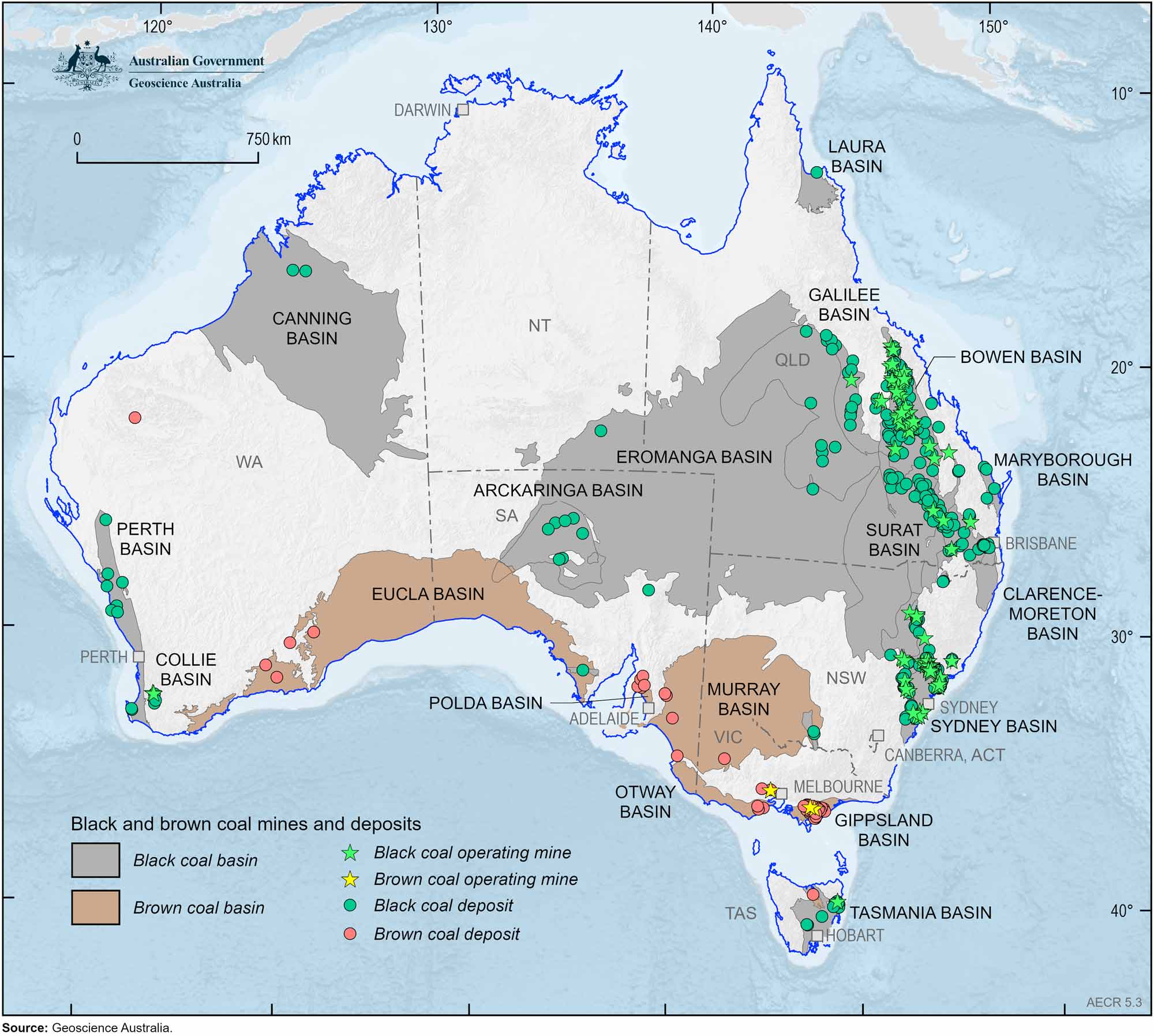
Figure 5.3 Australia's black and brown coal mines and deposits.
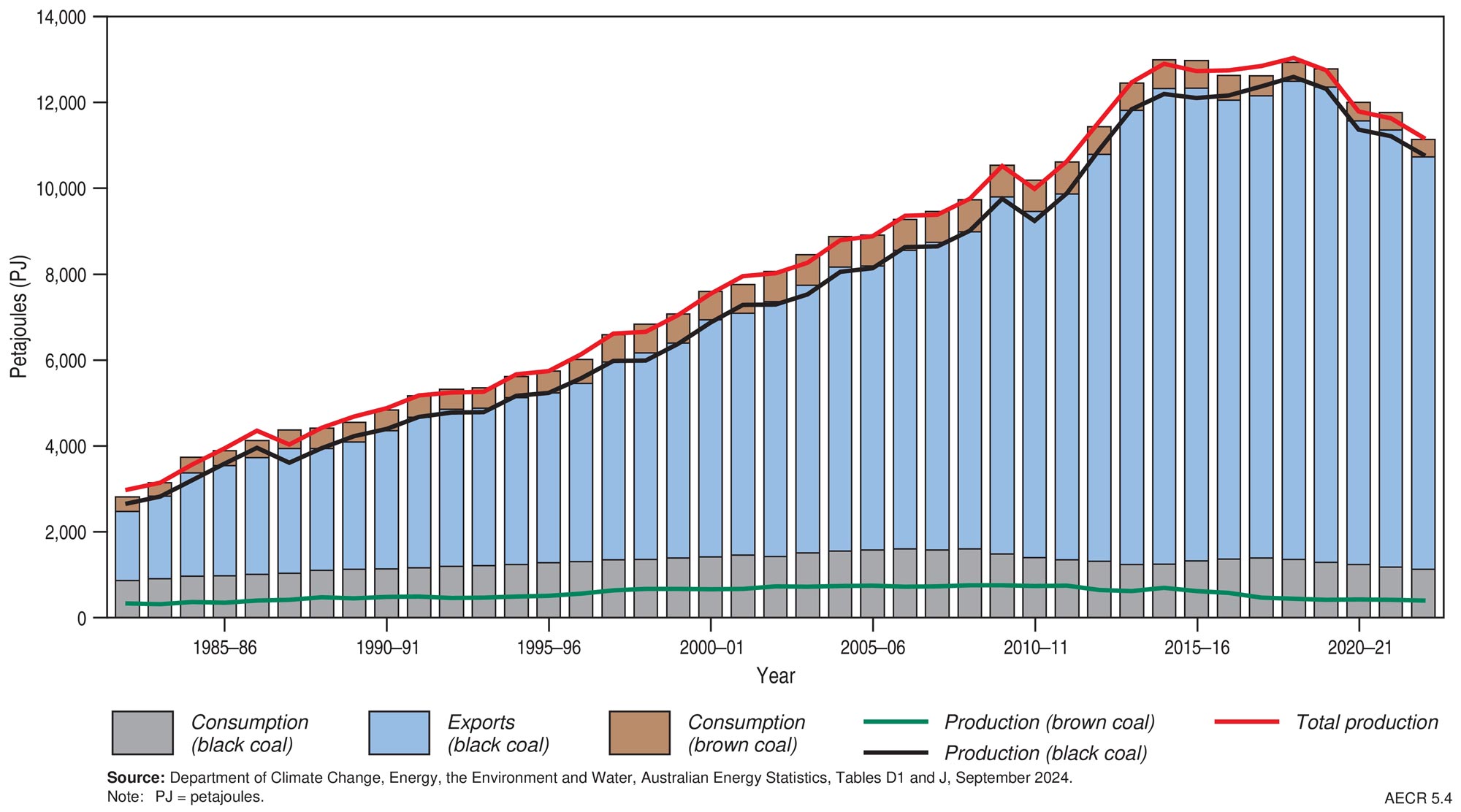
Figure 5.4 Australia’s coal production, consumption and exports, 1982–83 to 2022–23.
Australia accounts for 25% of world coal exports, ranking second behind Indonesia for total (black and brown) coal exports (Energy Institute, 2024), and exports the majority of its coal—capitalising on its abundant coal resources and strong ongoing coal demand from Asia. Australia exported 9,606 PJ of coal and coal products in 2022-23, which represents 56% of Australia’s total energy exports (; DCCEEW, 2024). Total coal export volumes in 2022–23 were 338 Mt, continuing a recent decline after peaking between 2015 and 2020 at ~390 Mt per year. Over the same period, the total value of coal exports increased by an average rate of 12% per year, from $40.0 billion in 2013–14 to $127.4 billion in 2022–23. In 2023, the average Newcastle thermal coal spot price decreased to US$173/t, from the high of US$359/t in 2022, and the Australian east coast premium hard coking coal spot price averaged US$293/t, down from US$364/t in 2022 (DISR, 2023b).
During 2023, Russian coal exports continued to be affected by international sanctions and Indonesian production increased in order to meet domestic and international demand (IEA, 2023b). Despite China lifting restrictions on Australian coal imports in early 2023, Australian coal exports experienced a 5.6% (567 PJ; 20 Mt) decline in 2022–23 due to regional flooding events and softening demand (DCCEEW 2024; DISR, 2024). Australian coal exports to Japan and the EU increased and exports to South Korea, India and Taiwan fell (DISR, 2024).
References
ABS (Australian Bureau of Statistics), 2024. Mineral and Petroleum Exploration, Australia, Table 5. Released 4 March 2024.
Federal Institute for Geosciences and Natural Resources (Bundesanstalt für Geowissenschaften und Rohstoffe [BGR]), 2024. BGR Energy Data 2024 – Data and developments concerning German and Global Energy Supplies.
DCCEEW (Department of Climate Change, Energy, the Environment and Water), 2024. Australian Energy Update, (last accessed June 2025).
DISR (Department of Industry, Science and Resources), 2023. Resources and Energy Quarterly: December 2023 (last accessed June 2025).
DISR (Department of Industry, Science and Resources), 2024. Resources and Energy Quarterly: September 2024 (last accessed June 2025).
Energy Institute, 2024. Statistical Review of World Energy.
Hughes, A., Britt, A., Pheeney, J., Morfiadakis, A., Kucka, C., Colclough, H., Munns, C., Senior, A., Cross, A., Hitchman, A., Cheng, Y., Walsh, J., and Jayasekara, A., 2025. Australia’s Identified Mineral Resources 2024. Geoscience Australia, Canberra.
IEA (International Energy Agency), 2023. Coal 2023 Analysis and forecast to 2026.
Data download
Data tables and full report are downloadable from the Geoscience Australia website.